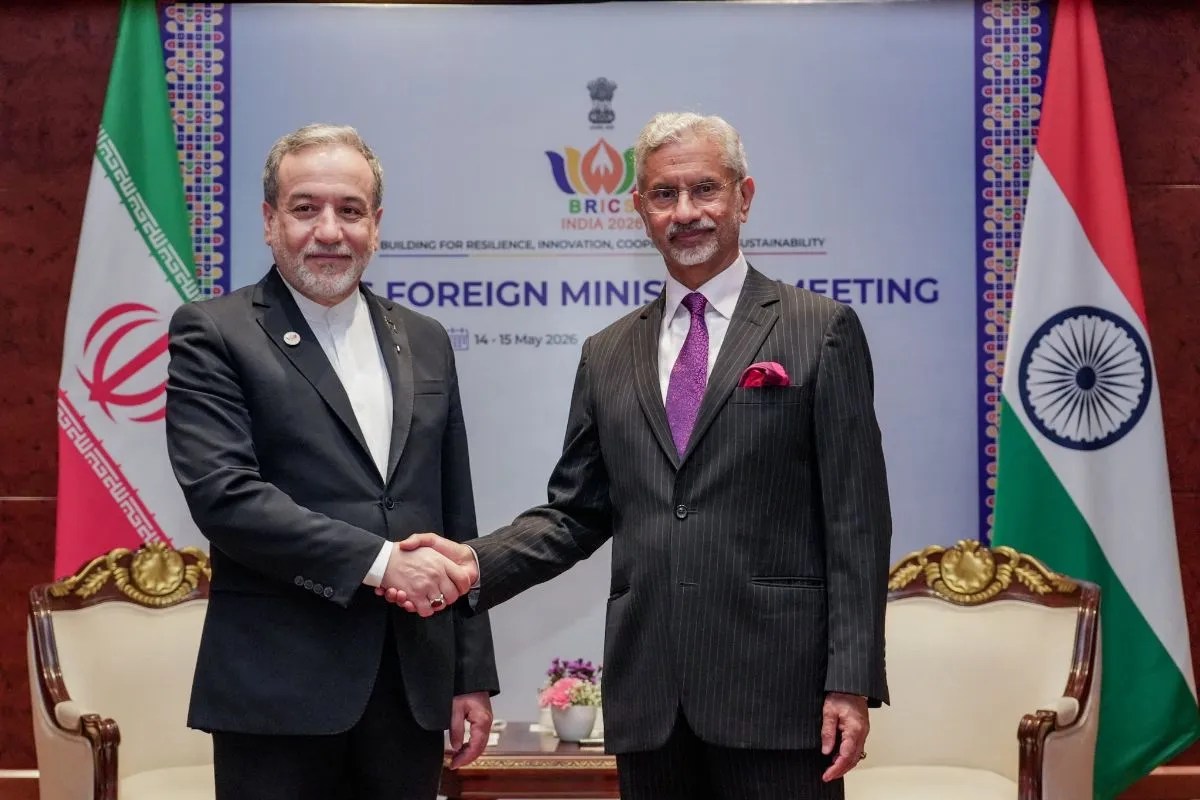
Mainstream media loves a photo-op. They see Indian External Affairs Minister S. Jaishankar shaking hands with Iranian Foreign Minister Abbas Araghchi and immediately churn out predictable headlines about "strengthening bilateral ties," "regional stability," and "strategic partnerships."
It is a comforting narrative. It is also entirely divorced from geopolitical reality. For a more detailed analysis into similar topics, we recommend: this related article.
The lazy consensus dominating current analysis suggests that these high-level meetings are a masterclass in strategic autonomy—a sign that New Delhi can seamlessly balance its relationships with Washington, Riyadh, Tel Aviv, and Tehran all at once. The conventional wisdom insists that Chabahar Port is the ultimate gateway to Central Asia and that India holds significant leverage in smoothing over Middle Eastern volatility.
This is a fundamental misreading of the chess board. For additional information on the matter, in-depth analysis is available on USA Today.
The truth is much colder. India and Iran are trapped in a cycle of performative diplomacy, chasing a strategic alignment that died the moment global supply chains fractured into ideological blocs. New Delhi is not exercising leverage; it is managing a legacy relationship that yields diminishing returns, while Tehran is looking for an economic lifeline that India cannot legally or practically provide.
The Chabahar Illusion
Let us talk about the elephant in the room: Chabahar Port. For a decade, policy analysts have hailed this project as India’s geopolitical masterstroke—a brilliant bypass around Pakistan to access Afghanistan and Central Asia.
It looks great on a map. In practice, it is a ghost town compared to its potential.
The Reality Check: While India signed a 10-year contract to develop and operate the Shahid Beheshti terminal at Chabahar, the project remains chronically choked. Not by a lack of political will, but by the structural reality of the global financial system.
You cannot run a world-class transit hub on exceptions and waivers.
I have watched corporate entities and logistics giants back away from Chabahar the second their compliance officers look at the secondary sanctions framework. American sanctions on Iran are not a hurdle you jump over; they are a brick wall. No serious global shipping line is going to risk its access to the US financial system or western maritime insurance networks to move a few thousand containers through a port that is perpetually stuck in geopolitical limbo.
Furthermore, the premise that Chabahar opens up Central Asia ignores the ground reality. Central Asian republics are already deeply integrated into China’s Belt and Road Initiative (BRI). Beijing does not hold meetings to discuss "potential synergy"; they lay tracks, build pipelines, and buy up mines. Hoping that a single, sanctions-hobbled port will allow India to outcompete China in Russia's backyard is not a strategy. It is wishful thinking.
The Energy Deficit That Can't Be Fixed
The most glaring flaw in the "deepening bilateral ties" narrative is the total collapse of the core economic pillar that used to bind New Delhi and Tehran: oil.
Before 2019, India was one of Iran's top oil buyers. Then came the end of US sanctions waivers. India cratered its Iranian oil imports to zero. Zero.
India's Oil Import Structure (Pre-2019 vs. Present)
+-------------------+-------------------+-------------------+
| Era               | Iranian Volume    | Primary Source    |
+-------------------+-------------------+-------------------+
| Pre-2019          | Top 3 Supplier    | Diversified ME    |
| Present           | 0%                | Russia / KSA / UAE|
+-------------------+-------------------+-------------------+
New Delhi replaced Iranian crude primarily with discounted Russian oil and stable flows from the Gulf monarchies. If you think Iran forgets this, you do not understand Persian diplomacy.
Tehran knows exactly where India stands. When push comes to shove, New Delhi will always prioritize its multi-billion-dollar trade relationship with the United States and its burgeoning defense partnerships with Israel and the UAE over its historical sentimentality for Iran.
Therefore, when Jaishankar and Araghchi sit down to discuss "economic cooperation," they are playing a game of words. India cannot buy Iranian oil. Iran cannot easily buy Indian goods because the rupee-rial mechanism is plagued by structural trade imbalances—India simply does not import enough non-sanctioned goods from Iran to keep the account funded.
We are left with a transactional relationship where neither side can trade the items they actually want.
The Flawed Premise of Middle East Mediation
Whenever tensions spike in the Middle East, commentators speculate on whether India can act as a bridge or a stabilizing force. This question assumes a level of diplomatic influence that does not exist in the real world.
Let us dismantle the "People Also Ask" consensus: Can India mediate between Iran and Israel?
Absolutely not. And it should not try.
Mediation requires either massive leverage or absolute neutrality. India has neither in this context.
- The Israeli Alignment: Over the last decade, India’s defense, tech, and intelligence relationship with Israel has deep-rooted structural importance. Israel is a critical defense supplier to New Delhi.
- The Gulf Pivot: India’s economic future is tied to the UAE and Saudi Arabia via massive investment corridors, remittances, and energy security. Both nations view Iran’s regional ambitions with deep suspicion.
- The Minimalist Iranian Position: Iran’s regional strategy relies on its axis of proxy networks. India has zero influence over these groups and zero desire to engage with them.
When India calls for "restraint" and "dialogue" in the Middle East, it is not offering a solution. It is ducking for cover. New Delhi's primary objective in the region is purely defensive: protect the millions of Indian expatriates working in the Gulf, secure maritime trade lanes through the Red Sea and the Persian Gulf, and ensure energy prices do not spike to a level that destroys India's domestic fiscal balance.
To suggest that a meeting in New Delhi can alter the trajectory of the Iran-Israel shadow war is an exercise in geopolitical vanity.
The High Cost of Strategic Autonomy
The downside to my contrarian view is obvious: it forces an admission that "Strategic Autonomy" has severe limits. It is an uncomfortable truth for Indian policymakers who pride themselves on being friends with everyone.
But pretending a relationship is robust when it is structurally hollow carries a real cost.
By constantly trying to revive the dead horse of Indo-Iranian economic integration, India risks sending mixed signals to its partners in the Quad and the I2U2 group (India, Israel, UAE, USA). It expends diplomatic capital on bilateral meetings that yield nothing but vague joint statements about "historical ties" and "cultural affinity."
History does not pay the bills. Cultural affinity does not protect shipping lanes from drone attacks.
If New Delhi wants to be a true global power, it must stop treating diplomacy like a collection of historical artifacts. The partnership with Iran was vital in the 1990s and 2000s when India was starved for energy and needed a counterweight to Pakistan’s influence in Kabul.
That world is gone. Pakistan is economically paralyzed. Afghanistan is under Taliban rule, and Tehran is increasingly dependent on Beijing for economic survival, symbolized by their 25-year strategic accord. Iran has made its choice; it has leaned squarely into the China-Russia axis.
Stop Talking About Potential, Face the Ledger
Look at the hard data, not the diplomatic press releases. Look at the trade volumes. Look at the stalled infrastructure projects. Look at the conflicting geopolitical alignments where India aligns with the West to counter China, while Iran signs strategic pacts with Beijing to survive Western pressure.
The New Delhi meeting was not a breakthrough. It was a maintenance check on a machine that has no fuel.
India needs to stop romanticizing its relationship with Iran. It is time to treat it for what it is: a highly constrained, strictly transactional, low-yield engagement that must be managed, not celebrated.
Stop looking for a grand strategic alignment where there is only a divergence of realities.