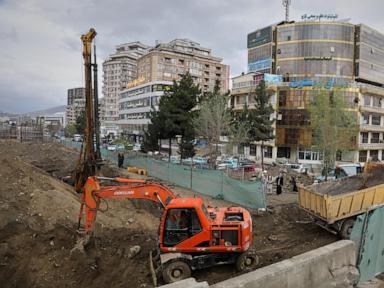
The skyline of Kabul is no longer defined by its mountains, but by the relentless skeletons of half-finished high-rises and the widening paths of asphalt that ignore anything in their way. Under the current administration, the city is undergoing a violent architectural rebirth that prioritizes traffic flow and modern optics over the sanctity of the past. Nowhere is this more evident than in the destruction of centuries-old graveyards. As the municipal authorities push through a master plan to "beautify" and "civilize" the capital, the dead are being evicted to make room for roundabouts and commercial strips.
This isn't just about urban planning. It is a raw display of power. By clearing away the literal foundations of Kabul’s social history, the government is signaling that the future belongs to those who hold the shovels, not those who hold the memories. For families who have visited these plots for generations, the choice is simple and brutal: exhume your ancestors within days or watch the bulldozers do it for you.
The Economics of Displacement
Urbanization in Afghanistan has historically been a chaotic, organic process. The current regime, however, views this chaos as an affront to their image of a disciplined state. They are obsessed with order. To achieve it, they have authorized the demolition of thousands of homes and the clearance of vast tracts of land that were previously considered untouchable.
The business logic is straightforward. Land in Kabul is the most valuable commodity in a country largely cut off from international banking. Real estate serves as a primary vehicle for domestic investment. By widening roads and clearing central districts, the municipality increases the value of the surrounding plots, which are often handed over to well-connected developers. The displaced—whether living or dead—receive little to no compensation.
A road expansion project is rarely just a road. It is an artery designed to pump capital into new commercial zones. In neighborhoods like Deh Dana or the fringes of the old city, the expansion of the "Kabul New City" project requires the removal of obstacles that were once protected by religious or social taboo. Today, those taboos are being systematically dismantled.
The Bureaucracy of Exhumation
When a cemetery is slated for destruction, the notice is often a simple flyer or a public broadcast. Families are given a window—sometimes as short as one week—to move the remains of their loved ones. This creates a desperate, macabre market for labor and new burial plots.
Transportation costs for remains, the price of new shrouds, and the fees for a plot in a more distant, less "valuable" cemetery fall entirely on the citizens. Those who cannot afford to move their dead are forced to watch as heavy machinery churns the earth. It is a clinical, unsentimental process. The municipality argues that these cemeteries are "unofficial" or that the land is needed for public utility, but the public utility is often a four-lane highway that serves a fraction of the population.
The Myth of Legal Recourse
In previous decades, land disputes could drag on for years in a maze of local councils and court appeals. That system has been replaced by a top-down mandate. If the Ministry of Urban Development and Land decides a neighborhood needs a plaza, the neighborhood disappears.
There is no meaningful mechanism for appeal. To protest is to risk being labeled an enemy of progress or a violator of the new state's vision. This has shifted the dynamic of the city from one of community-based growth to one of state-managed demolition. The psychological impact on the residents is profound. They are living in a city that no longer recognizes their right to occupy space, even in death.
The Structural Erasure of History
Kabul is a city of layers. Every time a bulldozer cuts through a hillside to widen a path, it isn't just moving dirt; it is erasing a physical record of the people who lived there through the British wars, the Soviet occupation, and the civil wars.
The current administration views these historical layers as clutter. They prefer the aesthetics of Gulf-style modernism—glass facades, wide boulevards, and sterile public squares. But this "modernity" is thin. It lacks the infrastructure of a truly functional city. While the roads are getting wider, the electrical grid remains intermittent, and the sewage system is practically non-existent.
Infrastructure as Propaganda
The speed of these projects is a key part of the government’s narrative. By showing "results" in the form of paved roads and cleared streets, they attempt to demonstrate a level of competence and control that their predecessors lacked. It is a visual performance of governance.
- Road Widths: Many primary routes are being expanded to 60 meters, regardless of the existing density.
- Commercial Zoning: Residential areas are being rezoned for retail without providing alternative housing.
- Green Spaces: Parks are being planned on cleared land, yet they often remain gated and inaccessible to the very people who were displaced to create them.
The human cost is a secondary concern. For a regime seeking international recognition and domestic stability, the appearance of a "clean" and "ordered" capital is a primary objective. They are building a stage, not a home.
The Logistics of a Flattened Society
The destruction of graveyards also serves a darker, perhaps unintentional, sociological purpose: it severs the connection between the people and their specific patches of land. When you remove the graves, you remove the anchor.
Families who have lived in the same district for a century are suddenly unmoored. They move to the outskirts, to unplanned settlements where the cycle of displacement will eventually catch up with them again. This creates a transient, more manageable population. It is easier to govern people who have no roots to defend.
The "New Kabul" is being built on a foundation of pulverized brick and bone. The engineering firms contracted for these works are often the same ones that handled military contracts in the past, now rebranded to suit the new masters. They work with a terrifying efficiency. They do not stop for heritage sites. They do not stop for shrines. They certainly do not stop for the weeping of those watching their family plots being turned into a parking lot.
A City Without a Soul
If you walk through the newly cleared areas of Kabul, the air is thick with the dust of old homes. The "beautification" projects have left the city feeling exposed. The narrow, shaded alleys that provided a respite from the harsh sun and a sense of community are being replaced by vast, hot expanses of concrete.
The planners argue that this is necessary for a modern economy. They claim that traffic congestion was the primary hurdle to Kabul’s growth. But a city is more than its traffic flow. It is a collective memory. By treating the city like a blank slate, the authorities are ignoring the fact that people are not just components in a machine.
The graves were the last line of defense against the total commercialization of the city. Now that those lines have been breached, nothing is sacred. The malls and the "smart" apartments that rise in their place will be occupied by a new elite, while the original inhabitants are pushed further into the shadows of the mountains.
The bulldozers are still running. They run through the night under floodlights, a constant hum that reminds every resident of Kabul that their presence is temporary. The dead have made way. The living have no choice but to follow.
The transformation of Kabul is not an evolution; it is an eviction. When the last tombstone is crushed and the last boulevard is paved, the city will finally be "ordered." It will also be unrecognizable to anyone who ever loved it. The cost of this progress is not measured in Afghanis, but in the permanent loss of the city's identity.
Expect the pace to accelerate as the government seeks more land to monetize. The map of the city is being rewritten in real-time, and there is no eraser for the scars left behind.