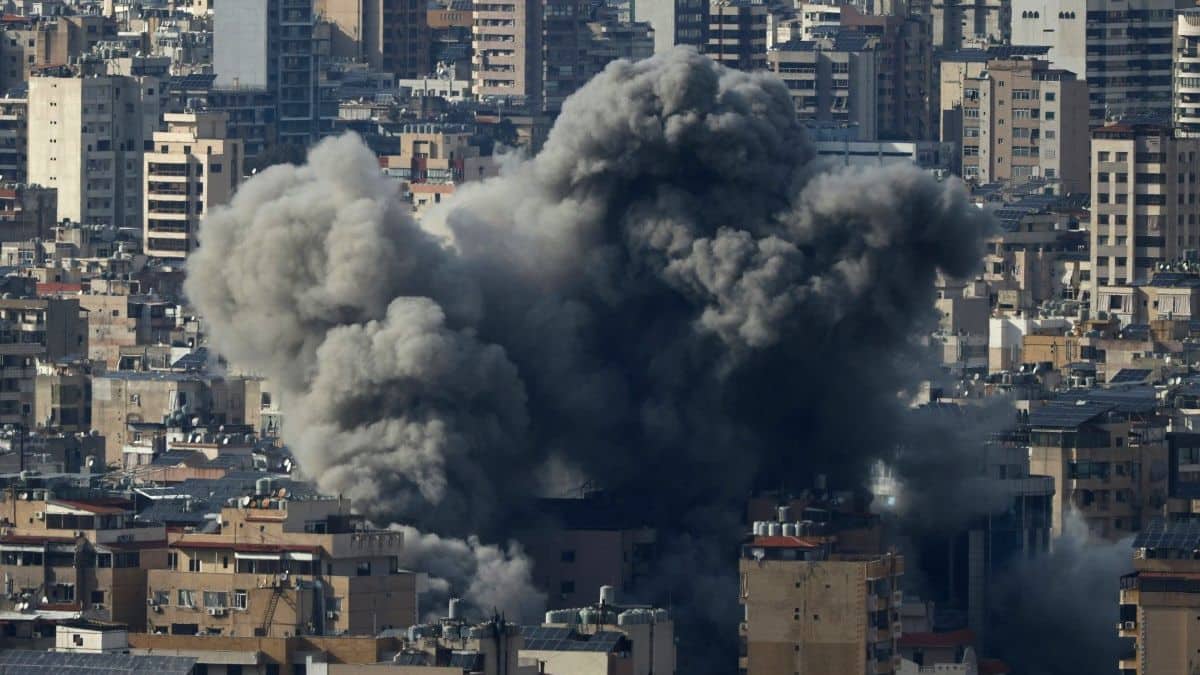
The sky over southern Lebanon does not just break; it shatters. It is a sound that lives in the marrow of your bones long after the smoke clears. When the Israeli munitions struck the residential apartment block in Nabatieh, the air didn't just move—it vanished. For a split second, there was a vacuum, a gasping silence, and then the world collapsed into a grey, choking powder.
Sixteen people were there one moment. They were gone the next.
Numbers like "sixteen" are easy for a news ticker to swallow. They fit neatly into a headline. They are digestible. But a number cannot describe the smell of pulverized limestone mixed with the metallic tang of blood and the scent of a dinner that was never finished. It cannot describe the specific shade of a child’s backpack sticking out from under a slab of reinforced concrete that weighs more than a tank.
To understand what is happening between Israel and Hezbollah, you have to look past the geopolitical chess moves and the talk of "buffer zones" or "limited operations." You have to look at the dust.
The Architecture of Fear
Nabatieh is not a frontline trench. It is a city of markets, schools, and narrow alleys where families have lived for generations. When the conflict intensifies, the geography of a home changes. A bedroom is no longer a place of rest; it is a potential tomb. A basement is not for storage; it is a sanctuary that might become a trap.
Consider a hypothetical resident named Omar. Omar is not a combatant. He is a man who spent twenty years working in the Gulf to save enough money to build a house with a red-tiled roof in his ancestral village. For Omar, the "escalation of hostilities" isn't a phrase used by a spokesperson in a suit. It is the vibration in his teacup that tells him a drone is loitering overhead. It is the agonizing decision of whether to stay and guard his life's work or flee north with nothing but the clothes on his back and the keys to a front door that might not exist by Tuesday.
When the air raid hit, the objective was reportedly a Hezbollah command cell. The reality, however, was a crater where a neighborhood used to be. The "collateral" in "collateral damage" has names. It has birthdays. It has favorite songs.
The technical term for this is "asymmetric warfare," but that is a sterile mask for a messy reality. One side possesses the most sophisticated aerial technology on the planet—jets that can delete a building from five miles up with surgical precision. The other side operates from the shadows, embedded in the very fabric of the towns they claim to protect. In the middle are the civilians, caught in a vice where the only thing more dangerous than staying is leaving.
The Invisible Stakes
Why does this keep happening? To answer that, you have to understand the ghosts of 2006. That was the last time the border truly ignited, and the scars from that summer never quite faded. They just waited.
Israel views the northern border as an open wound. Thousands of its own citizens have been displaced from towns like Kiryat Shmona, living in hotels for months, their lives on indefinite pause. The Israeli government feels a mounting, frantic pressure to "push back" Hezbollah, to ensure that the elite Radwan forces cannot recreate the horrors of October 7th on a northern front.
Hezbollah, meanwhile, has tied its fate to the ruins of Gaza. They claim their rockets are a "support front," a way to bleed Israeli resources and force a ceasefire. It is a high-stakes gamble played with other people's lives. Every time a rocket crosses the Blue Line, an engine of destruction is fueled on the other side.
The tragedy of the sixteen killed in Nabatieh is that they are markers in a grim mathematical equation. Each death is a data point used to justify the next strike. It is a cycle that feeds on itself, a perpetual motion machine of grief.
The Weight of the Rubble
Rescue workers in Lebanon don't use the word "rescue" much anymore. They use the word "recovery."
When the white helmets of the Civil Defense arrive at a site like the one in Nabatieh, they aren't looking for miracles. They are looking for pieces. They dig with their hands because the rubble is too unstable for heavy machinery. They work in a silence that is occasionally broken by the buzzing of a "MK"—the colloquial Lebanese term for Israeli surveillance drones. The sound is a constant, rhythmic reminder that the eye in the sky is still watching, still deciding what constitutes a target.
Imagine the physical effort of moving a mountain of stone by hand. Imagine the psychological weight of knowing that the person you are digging for was your neighbor, your cousin, or the man who sold you bread this morning.
The world watches this through a lens of "intensification." We see maps with red arrows pointing north and blue arrows pointing south. We hear analysts talk about "red lines" and "deterrence." But deterrence is a phantom. You cannot deter a mother who has lost her children. You only radicalize her sorrow.
The Sound of the Silence After
There is a specific kind of silence that follows a massive explosion. It isn’t the absence of noise; it is a ringing, pressurized void. In that silence, the political justifications of both sides feel hollow.
Does the death of sixteen civilians make Galilee safer? Does it bring Gaza closer to peace? Or does it simply ensure that the next generation of Lebanese children will grow up looking at the sky not with wonder, but with a calculated, instinctive terror?
The conflict is moving toward a tipping point. The rhetoric is hardening. The "limited" nature of the raids is expanding, stretching the definition of the word until it snaps. We are witnessing the slow-motion collapse of a border, and the human cost is being paid in the currency of Nabatieh’s dust.
As the sun sets over the Mediterranean, the smoke from the southern hills drifts toward the sea. In the ruins of the apartment block, someone's phone is likely ringing under a pile of debris. A relative is calling, hoping for a voice, hoping for a sign of life.
The phone rings and rings until the battery dies.
No one answers.
The silence that follows is the truest report of the war. It is a silence that cannot be captured in a briefing or summarized in a headline. It is the heavy, suffocating weight of sixteen empty chairs at sixteen different tables, while the world waits for the next shatter in the sky.