The room in Munich felt smaller than it actually was. High ceilings and gilded moldings usually offer a sense of breathing room, but when the air is thick with the scent of expensive coffee and the quiet desperation of a continent at war, the walls close in. It was here, and in similar corridors across the Atlantic, that the friction began to heat up. Not just a friction of policy, but of personality.
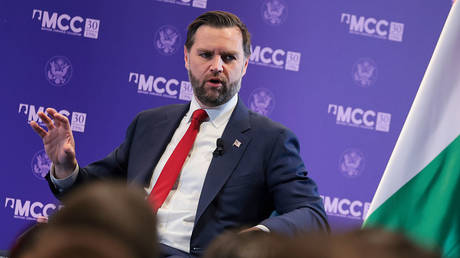
J.D. Vance sat with the calculated stillness of a man who knows exactly what he wants to say and exactly how much it will annoy the people he’s saying it to. On the other side of a digital and ideological divide stood Volodymyr Zelensky, a man whose wardrobe has become a uniform of existential survival. Between them lay Viktor Orban, the Hungarian leader who has turned the art of being a thorn in the side of the European Union into a national brand.
When Zelensky voiced what many described as a threat toward Orban—suggesting that the Hungarian leader was playing a dangerous game that could have consequences—it wasn't just another soundbite. It was a spark.
Vance didn't just disagree. He went for the jugular. He called the rhetoric preposterous.
Think about the weight of that word. It isn't just a synonym for "wrong." It’s an accusation of absurdity. It’s the kind of word a teacher uses for a student who claims the dog ate their homework, or a prosecutor uses for an alibi that defies the laws of physics. By using it, Vance wasn't just defending Orban; he was rewriting the hierarchy of the room.
The Grinding Gears of Sovereignty
To understand why this matters, you have to look past the suits and the teleprompters. Imagine a small village where every neighbor has agreed to a set of rules. One neighbor, let’s call him Viktor, decides he doesn’t like the way the village fund is being spent. He starts locking his gate. He whispers to the outsiders. He refuses to sign the communal petitions.
The village leader, desperate because his own house is literally on fire, turns to Viktor and says, "If you don't help us, there will be a reckoning."
In the world of high-stakes diplomacy, that "reckoning" is a terrifying phrase. It implies the breaking of bonds. It implies that the rules of the club no longer apply.
Vance’s intervention serves as a shield for the dissenter. His argument is built on a specific, jagged foundation: the idea that no matter how much we dislike a neighbor's choices, we do not get to bully them into submission—especially when we are asking for their money, their weapons, or their silence.
The Senator from Ohio is tapping into a very old, very American vein of skepticism. It’s the feeling that the elites in Brussels and Washington have forgotten what it’s like to have a border that means something, or a budget that has a bottom. When he defends Orban, he isn't necessarily endorsing every policy coming out of Budapest. He is defending the right to be difficult. He is defending the right to say "no" to the collective.
The Sound of Breaking Glass
Politics is usually a game of whispers and carefully calibrated leaks. What we are seeing now is the era of the megaphone.
Zelensky’s frustration is visceral. You can see it in the lines around his eyes. He is leading a country where the sirens never stop. For him, Orban isn't a "sovereign leader with a different perspective." Orban is a roadblock in the path of survival. Every day that Hungary stalls an aid package or questions a NATO maneuver, Ukrainian soldiers pay the price in a currency that cannot be minted: blood.
When a man in that position speaks, he doesn't use the language of a diplomat. He uses the language of a commander.
But Vance sees a different danger. He sees a world where the "defenders of democracy" are starting to sound remarkably like the people they claim to oppose. If you can only have a democracy as long as you agree with the majority, do you actually have a democracy at all? Or do you have a polite form of authoritarianism?
This is the invisible stake. It isn’t just about a billion dollars here or a tank battery there. It is about whether the West is a monolith or a mosaic. A monolith is strong until it cracks. A mosaic is messy, but it can shift.
The Ghost in the Machine
Consider the hypothetical voter in a place like Middletown, Ohio. They aren't reading the transcripts of the European Council. They aren't tracking the movement of the 3rd Armored Brigade. What they see is a world that feels increasingly out of control. They see their own leaders more concerned with the feelings of a president in Kyiv than the price of eggs in Cincinnati.
Vance knows this person. He was this person.
His critique of Zelensky’s "threat" is a signal to that voter. It says: "I see the overreach. I see the arrogance." It’s a powerful narrative because it frames the outsider as the true defender of the little guy. In this story, Orban is the small shopkeeper standing up to the corporate conglomerate. Zelensky is the face of the conglomerate.
It’s a total inversion of the standard media narrative.
The standard narrative says Zelensky is David and Putin is Goliath. But in Vance’s retelling, the roles are shifting. In the halls of the U.S. Senate, the "David" is the one standing up to the massive, multi-national pressure to keep a war going indefinitely without a clear exit strategy.
The Weight of the Word Preposterous
When the video of Vance’s comments began to circulate, the reaction was predictable. One side saw a brave truth-teller calling out a foreign leader for overstepping his bounds. The other side saw a cynical politician undermining a hero of liberty to score points with a populist base.
Both sides are missing the deeper shift.
We are watching the death of the Post-Cold War consensus. For thirty years, there was a script. You praised your allies. You condemned your enemies. You kept your internal bickering behind closed doors.
That script has been shredded.
Now, the bickering is the point. The conflict is the content. When Vance slams a threat as "preposterous," he is inviting the audience to look at the cracks in the alliance. He is asking us to admit that the "united front" is actually a collection of terrified, self-interested, and often angry nations who are tired of being told what to do.
It is uncomfortable. It feels dangerous.
The stakes are not just the borders of Ukraine or the sovereignty of Hungary. The stake is the very language of international relations. If we can no longer talk to each other without threatening "consequences," then we aren't in a community anymore. We are in a standoff.
Vance’s words act as a mirror. They reflect a growing segment of the Western world that is exhausted. Exhausted by the moral certainty of leaders who don't have to live with the consequences of their rhetoric. Exhausted by the idea that there is only one "right" way to view a complex, historical tragedy.
The Silence After the Shout
Imagine the quiet moment after the cameras turn off. Zelensky returns to a map of a burning country. Vance returns to a briefing on a struggling economy. Orban returns to a capital that feels increasingly isolated from its peers.
There is no easy "conclusion" to this. There is no neat bow to tie around the animosity.
The tension between the need for collective action and the desire for national independence is the defining struggle of our century. It’s the friction that creates the heat, and eventually, the fire.
We are living through the moment where the polite mask of diplomacy has slipped, revealing the raw, jagged teeth of national interest underneath. You can call it a breakdown. You can call it a tragedy. But as the echoes of Vance’s "preposterous" remark fade into the next news cycle, one thing is certain.
The world where we all pretended to agree is gone, and it isn't coming back.
The man in the green t-shirt and the man in the blue suit are no longer speaking the same language, even when they use the same words. They are staring at each other across a chasm that is widening by the hour, and neither one is willing to be the first to look down.
In the end, the most "preposterous" thing of all might be the belief that this can end any other way than in a total reimagining of what it means to be an ally in a world that is falling apart.
The fire is burning. The wind is picking up. And the neighbors are still arguing about the fence.