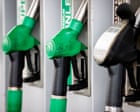
The pump handle is always colder than you expect it to be. In a forecourt just outside Newry, the steel feels like an ice pick against the palm. It is a Tuesday morning, the sky a bruised purple, and the digital display on the terminal is flickering through a sequence of numbers that felt like a bad dream only three months ago.
Click. The trigger locks. The tank is full, but the wallet is empty. For a more detailed analysis into this area, we suggest: this related article.
For the people of Northern Ireland, the geopolitical tremors of the Middle East aren't just headlines on a flickering television screen or abstract shifts in a London stock exchange. They are immediate. They are physical. When the first missiles crossed the borders in the Iran conflict, the shockwaves traveled six thousand miles in an instant, manifesting here as the sharpest, most aggressive price hikes in the United Kingdom.
Northern Ireland is currently the tip of the spear. While the rest of the UK grapples with the creeping inflation of a world at war, this corner of the map is seeing fuel prices surge with a velocity that defies local logic. It is a quiet crisis, measured in pence per liter and the growing silence of empty roads. For additional details on this topic, detailed coverage is available at The Guardian.
The Mechanics of a Crisis
Consider a hypothetical driver named Elias. Elias runs a small delivery van between Belfast and Derry. For years, his overhead was a predictable line item—a steady hum in the background of his life. But fuel isn't just a commodity for Elias; it is the blood of his business. When the conflict in Iran ignited, the global oil markets did what they always do: they panicked.
Oil is a nervous traveler. It reacts to the mere threat of a closed strait or a sabotaged refinery. But why is Northern Ireland bearing the brunt?
The answer lies in the fragile architecture of our supply chains. Unlike the mainland, which benefits from a more integrated network of refineries and storage, Northern Ireland’s market is smaller, more isolated, and more sensitive to the immediate "spot price" of fuel. We are the last stop on a very long, very expensive journey. When the global price of crude oil ticks upward because of a drone strike in a desert half a world away, the local retailers here—operating on razor-thin margins—have no choice but to pass that cost onto the person holding the pump.
The numbers tell a story that the heart already knows. Since the onset of the hostilities, the average price of a liter of diesel in Northern Ireland has outpaced the rises seen in Manchester, London, or Cardiff. We aren't just paying more; we are paying more faster.
The Invisible Tax of Geography
There is a specific kind of anxiety that comes with watching the "Cost of This Sale" ticker climb faster than the "Liters Delivered" ticker.
In the rural heartlands of Tyrone and Fermanagh, a car isn't a luxury. It is a lifeline. There is no Tube. There are no sprawling tram networks. If you want to get your child to a doctor, or if you want to get yourself to a shift at the factory, you must burn fuel. This makes the price surge a regressive tax on the very act of living.
We often talk about the "energy transition" as if it’s a choice made in a boardroom. For the family sitting around a kitchen table in Omagh, the transition isn't an environmental goal; it's a forced retreat. They are driving less. They are visiting parents less. They are shrinking their worlds because the cost of the horizon has become too steep.
The war in Iran has effectively placed a blockade on the North Irish budget. It’s a secondary front of the conflict, fought not with ballistics, but with the quiet desperation of a pensioner deciding whether to heat the living room or drive to the supermarket.
Why the Surge Won't Wait
Market analysts use words like "volatility" and "speculation." They talk about the "risk premium" associated with Middle Eastern crude. But these terms act as a veil, obscuring the human reality.
When a major oil-producing region enters a state of war, the global supply doesn't just drop; the expectation of future supply collapses. Traders buy up futures, driving the price up today to hedge against a worse tomorrow. Northern Ireland's fuel retailers, who often lack the massive bulk-buying power of English supermarket giants, find themselves at the mercy of these daily fluctuations.
Imagine a bucket brigade where the bucket gets smaller every time it's passed. By the time the oil reaches the shores of Belfast Lough, it has been taxed by distance, taxed by risk, and taxed by the sheer uncertainty of a world on fire.
The Ripple Effect
The cost of a liter of petrol is the first domino.
When the delivery van costs more to run, the bread inside it costs more to buy. When the tractor costs more to fill, the potatoes it harvests become a premium product. We are seeing a synchronized rise in the cost of existence. The Iran war didn't just change the price of fuel; it changed the chemistry of the local economy.
Small businesses are the first to feel the burn. The local florist, the independent courier, the mobile hairdresser—these are the people for whom a 15-pence rise in fuel is the difference between a profit and a loss. They cannot "leverage" their way out of this. They cannot "synergize" a solution. They simply have to work longer hours for less money, or pass the cost to a customer who is already struggling.
The Ghost of the Forecourt
There is a strange, somber atmosphere at the petrol stations these days. People don't make eye contact as they did before. They stare at the pump. They wait for the click.
We are living through a period where the "global" has become painfully "local." We are realizing, perhaps for the first time in a generation, how thin the thread is that connects our daily commute to the stability of a region thousands of miles away.
The surge in Northern Ireland is a warning. It is a symptom of a world where the margins of error have vanished. As the conflict continues, the pressure will only mount. There are no easy fixes. There is no magic valve to turn that will bring the prices back to the "before times."
Instead, there is only the reality of the morning air, the cold steel of the handle, and the relentless march of the numbers on the screen. We are all passengers in a vehicle we no longer control, watching the needle drift toward empty while the road ahead grows increasingly dark.
The woman at the next pump over catches my eye. She doesn't say anything. She just sighs, replaces the nozzle, and drives away slowly, as if trying to make every drop of that expensive liquid last just a few seconds longer.