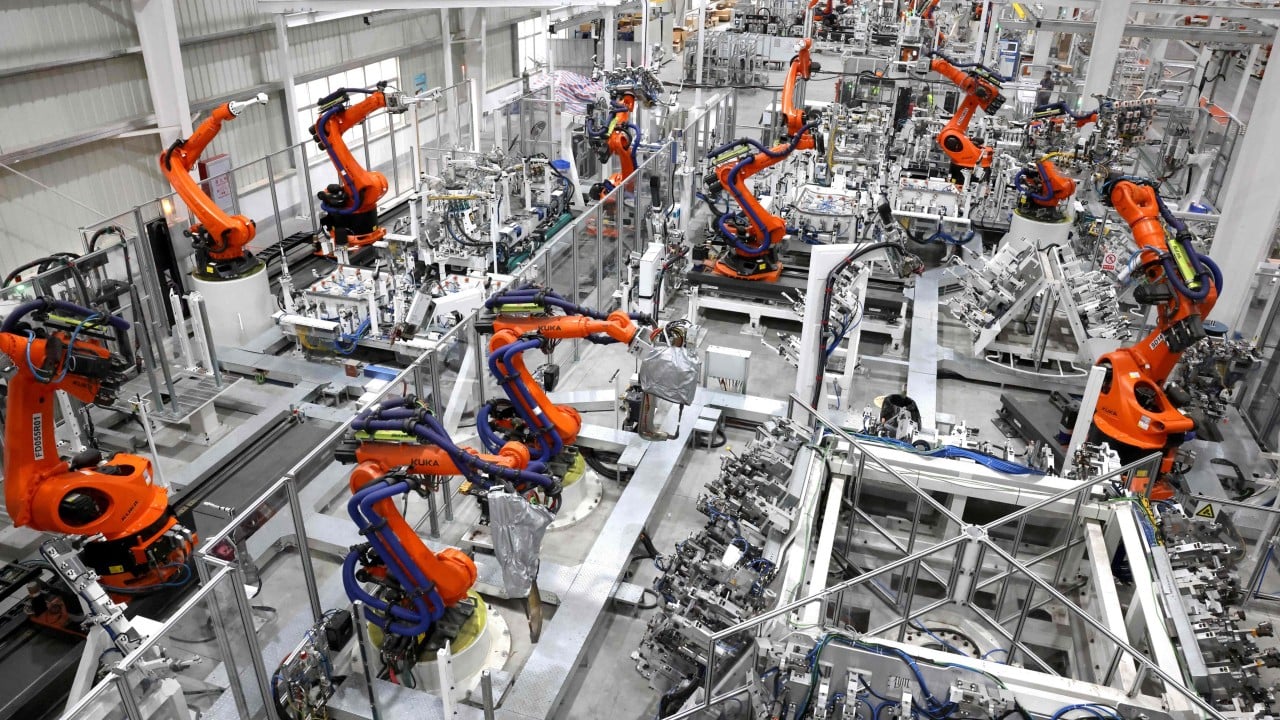
Western leaders keep waiting for China’s industrial engine to stall out. They point to an aging population, rising wages, or the massive debt bubbles in the property sector as proof that the peak has passed. They’re wrong. China isn’t just staying the world's factory floor. It’s moving into the penthouse. The reality is that the global supply chain has a center of gravity that isn't shifting back to the Atlantic, no matter how many tariffs get slapped on EVs or solar panels.
If you think this is still about cheap toys and t-shirts, you’re living in 2005. Today, it’s about high-end semiconductors, long-range batteries, and industrial robotics. The West needs to stop viewing this as a temporary surge and start treating it as a structural reality. Expanding on this idea, you can find more in: Stop Cheering for the Scotch Tariff Cut (It’s a Trap).
The Massive Scale of Chinese Industrial Subsidies
We often hear about "leveling the playing field." It’s a nice sentiment. But the field isn't just tilted; it’s been completely rebuilt. According to data from the Center for Strategic and International Studies (CSIS), China spends roughly 1.7% of its GDP on industrial subsidies. That’s more than double what most other nations even dream of spending.
This isn't just about throwing money at problems. It’s about vertical integration. When a Chinese company builds an electric vehicle, they aren't just assembling parts. They likely own the lithium mine in Africa, the processing plant in Sichuan, and the battery factory next door. They’ve eliminated the middleman at every single stage. Western firms often find themselves competing against an entire ecosystem rather than a single company. Observers at Harvard Business Review have also weighed in on this trend.
It’s hard to beat a competitor that controls the raw materials and the shipping lanes. You aren't just fighting a brand. You're fighting a sovereign industrial strategy.
Green Technology Is the New Battleground
The West wants a green transition. But right now, that transition is paved with Chinese hardware. Look at the numbers for solar power. China produces about 80% of the world’s solar modules. They didn't get there by accident. They spent a decade oversupplying the market, driving down prices, and forcing international competitors out of business.
Now, we see the same script playing out with Electric Vehicles (EVs). Brands like BYD are producing cars that are tech-heavy and incredibly cheap. They aren't just "good for the price." They’re just good. When the European Union or the United States adds duties to these cars, they’re trying to buy time. But time is only useful if you actually use it to build something better. So far, the West is mostly using that time to complain.
I’ve seen how this plays out in the battery sector. Contemporary Amperex Technology Co. Limited (CATL) doesn’t just supply Tesla. They set the standard for the entire industry. If you want the best energy density, you go to them. The idea that we can simply "reshore" this overnight is a fantasy. It takes decades to build that kind of specialized labor force and infrastructure.
Why Reshoring Is Harder Than It Looks
Politicians love the word "reshoring." It sounds patriotic. It promises jobs. But let's be real for a second. Building a factory in Ohio or Germany is vastly more expensive than building one in Shenzhen or Vietnam. It’s not just the wages. It’s the regulations, the permits, and the lack of a nearby supply base.
If a factory in China needs a specific screw or a specialized sensor, they can get it from a supplier three miles away. If a factory in the U.S. needs it, they might have to wait weeks for a shipment from overseas. That lag kills efficiency.
We also have a massive skills gap. China graduates millions of engineers every year. While the West has plenty of talented people, we don't have the sheer volume of technicians required to run these hyper-automated plants at scale. You can't just flip a switch and bring manufacturing back. You have to rebuild the entire culture of making things.
The Overcapacity Argument and Global Markets
The big talking point in Washington and Brussels lately is "overcapacity." The argument is that China is producing way more than its own people can buy, so it’s dumping the rest on the world at predatory prices. This is true. But for a developing nation in Southeast Asia or South America, "cheap and high-quality" isn't a threat. It’s an opportunity.
While the West builds walls, China is building bridges—literally—through the Belt and Road Initiative. They’re locking in markets that will be the growth engines of the next fifty years. If the U.S. refuses to buy Chinese EVs, those cars will just go to Brazil, Indonesia, or Nigeria. The West risks becoming an island of high-cost goods while the rest of the world standardizes on Chinese tech.
Recalibrating the Western Strategy
So, what do we do? Doubling down on protectionism feels good in an election year, but it’s a band-aid on a bullet wound. Recalibrating means acknowledging that we can’t win a price war. We have to win an innovation war.
- Focus on High-Value Moats: Stop trying to compete on commodity goods. The West needs to dominate the software, the high-end design, and the specialized machinery that the factories of the future require.
- Real Industrial Policy: The CHIPS Act was a start. But it can't be a one-off. There needs to be a sustained, multi-decade commitment to domestic production that survives different administrations.
- Friend-shoring Over Reshoring: We have to accept that we won't make everything at home. Building deep, reliable trade links with allies like Mexico, India, and Vietnam is the only way to create a supply chain that isn't dependent on a single point of failure.
This isn't about "beating" China in a zero-sum game. That ship has sailed. It’s about ensuring that the West remains relevant in a world where the manufacturing crown has moved East. Stop waiting for the collapse. It isn't coming. Start building instead.
If you're a business leader, stop looking at your supply chain through a 2019 lens. Diversify now. Don't wait for the next geopolitical flare-up to realize you're over-leveraged on a single region. Look at your logistics, find the bottlenecks, and invest in automation that offsets the labor cost gap. The era of easy, cheap globalization is over. The era of strategic, hard-fought industrial competition is just beginning. Get moving.