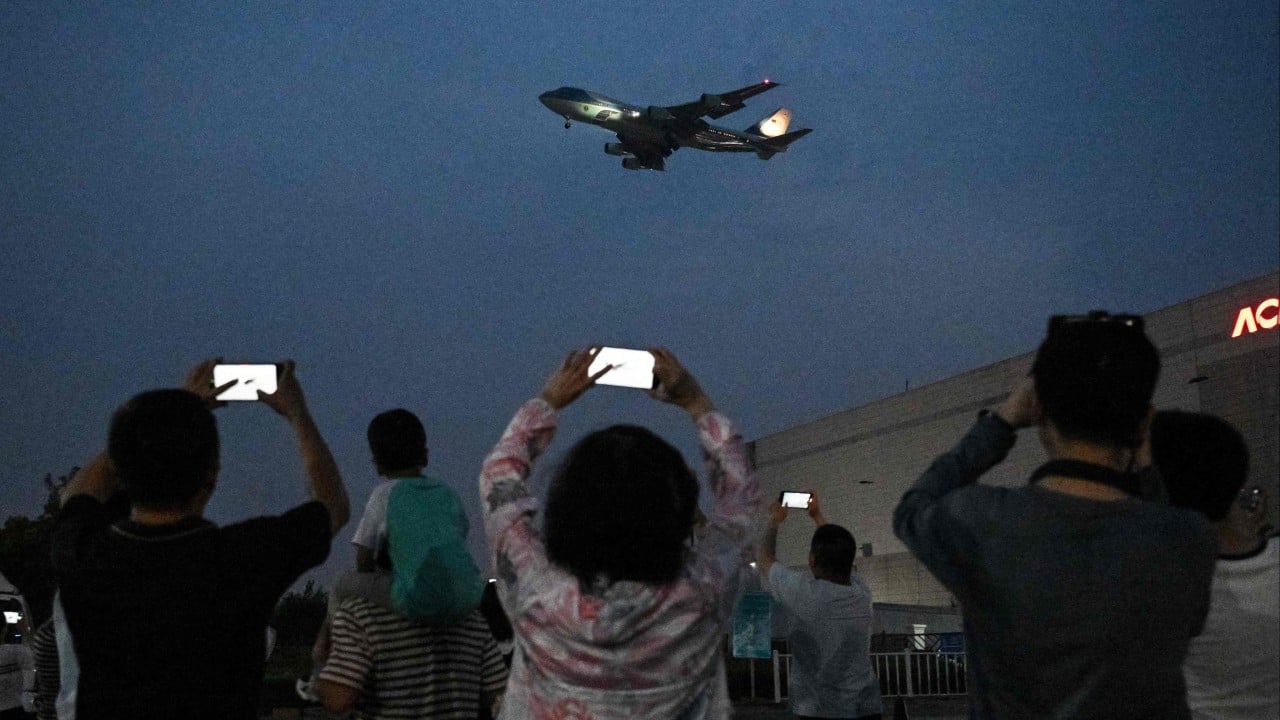
The sky over Beijing is rarely just a sky. It is a canvas for geopolitical theater, a space where the appearance of a specific silhouette can stop traffic and send millions of fingers racing across smartphone screens. When the modified Boeing 747—the one with the distinctive "United States of America" lettering across its polished blue-and-white fuselage—breaks through the haze, it isn't viewed as a mere airplane. To the onlookers below, it is a mobile sovereign territory, a three-story office building with wings, and a symbol of a power dynamic that both fascinates and frustrates a rising superpower.
This is the legend of Air Force One as seen through Chinese eyes. It is a story of obsession, not just with the machine, but with what the machine represents: an apex of technological and political status that China is currently racing to match.
The Metal Myth
Think of a middle-class office worker in Shanghai, let's call him Chen. Chen spends his commute scrolling through Weibo. He isn't particularly interested in American domestic policy. He doesn't follow the intricacies of the Senate. But he can tell you the exact range of a VC-25A. He knows about the mid-air refueling capabilities. He has seen the infographics detailing the "President’s Suite" and the medical operating room located just behind the cockpit.
For Chen and millions like him, the plane is a tangible manifestation of American "hard power." In Chinese social media circles, the aircraft is often referred to as the "Flying White House." This nickname carries a heavy weight. It implies that the American President never truly leaves home; he simply moves his fortress through the air.
The fascination isn't accidental. It is fueled by a mix of envy and a deep-seated respect for engineering. In the Chinese cultural context, "face" or mianzi is everything. To arrive in a vehicle that is essentially a nuclear-hardened bunker equipped with 85 onboard telephones and the ability to survive the electromagnetic pulse of a distant atomic blast is the ultimate expression of mianzi. It is the loudest possible statement of "I have arrived."
The Invisible Stakes of the Tarmac
When Donald Trump first stepped off that plane in Beijing during his presidency, the optics were analyzed with the precision of a laboratory experiment. The red carpet, the height of the stairs, the way the sunlight glinted off the polished engine cowlings—every detail was a data point.
The Chinese public watched the footage not just to see the leaders, but to witness the theater of the arrival. There is a specific psychological pull to seeing the most powerful man in the Western world emerge from a machine that costs roughly $200,000 per hour to operate. It creates a sense of awe that transcends language barriers.
But beneath the awe lies a sharper edge. The fascination is often a mask for a competitive drive. China is currently developing its own wide-body commercial jets, like the COMAC C929. Every time a high-resolution photo of Air Force One goes viral on a Chinese tech forum, it serves as a silent motivator. It is a benchmark. The subtext is always: When will we have our own version that makes the world stop and stare?
The Anatomy of an Obsession
Why does a specific aircraft capture the Chinese imagination more than, say, a nuclear submarine or a stealth drone?
The answer lies in its visibility. A submarine is a ghost; a drone is a shadow. Air Force One is a spectacle. It is a physical bridge between two worlds. It is also an object of intense scrutiny because it represents the fusion of luxury and lethality.
Consider the hypothetical scenario of a high-stakes negotiation. Two leaders sit in a room in the Forbidden City. Outside, parked at the airport, is a plane capable of acting as a command center for a global conflict. That physical presence changes the atmosphere of the room. It is a silent participant in every conversation.
Chinese netizens often debate the "secret" features of the plane with a fervor usually reserved for video game leaks. They discuss the thick shielding that protects the electronics. They wonder about the kitchen that can feed 100 people at a time. They analyze the flares and chaff dispensers hidden in the wings to deflect incoming missiles.
This isn't just geeky curiosity. It’s a way of processing the reality of American influence. By deconstructing the plane, they are deconstructing the empire. If you can understand the bolts and the wiring, the power becomes less mystical. It becomes something that can be studied, replicated, and eventually surpassed.
The Emotional Mirror
There is a sense of vulnerability in this fascination. To admire a foreign leader’s transport is to acknowledge a gap. For a country that prides itself on its "Great Rejuvenation," the sight of a 1980s-era Boeing 747 still commanding such global respect is a reminder that prestige isn't just about who has the newest technology, but who has the most enduring symbols.
The "Trump factor" added a layer of celebrity to the metal. His background in real estate and his penchant for gold-plated aesthetics resonated with a certain segment of the Chinese public that equates wealth with strength. The plane became an extension of his brand—a massive, flying skyscraper.
But the plane exists beyond any one president. It is a constant. It represents a level of institutional stability that is both envied and scrutinized. In a world where alliances shift like sand, the blue-and-white 747 remains a fixed point in the sky.
Beyond the Horizon
The conversation in the tea houses and digital forums is shifting. The fascination is maturing into a critique. People are starting to ask about the cost. They are looking at the aging fleet and the delays in the new "Air Force One" project—the upgraded VC-25B models.
There is a certain irony in watching the world’s most famous plane struggle with budget overruns and production delays. To the Chinese observer, this is a narrative arc they recognize: the titan showing signs of fatigue.
Still, whenever the wheels touch down on Chinese soil, the cameras will be there. The livestreams will start. Millions will watch a door open and a set of stairs extend. They aren't just watching a man walk onto a carpet. They are watching the weight of history, wrapped in aluminum and titanium, momentarily resting on their land.
The fascination persists because the plane is the ultimate human artifact. It is our ambition, our fear, and our desire for total control, all forged into a single, soaring shape. It is a reminder that we are still a species that looks to the heavens to see who truly holds the earth.
The engines roar. The ground trembles. The fortress rises, leaving nothing behind but a trail of white vapor and the quiet, persistent dreams of those watching from the ground.