The tea was likely still warm in the pot.
In apartment 4C, a woman named Oksana—though she could be any of us—had probably just kicked off her shoes. It was Friday night in Kharkiv. The kind of evening where the week’s weight begins to dissolve into the mundane comfort of a television hum or the rhythmic chopping of vegetables for tomorrow’s soup. These are the small, invisible threads that weave a life together.
Then the sound came.
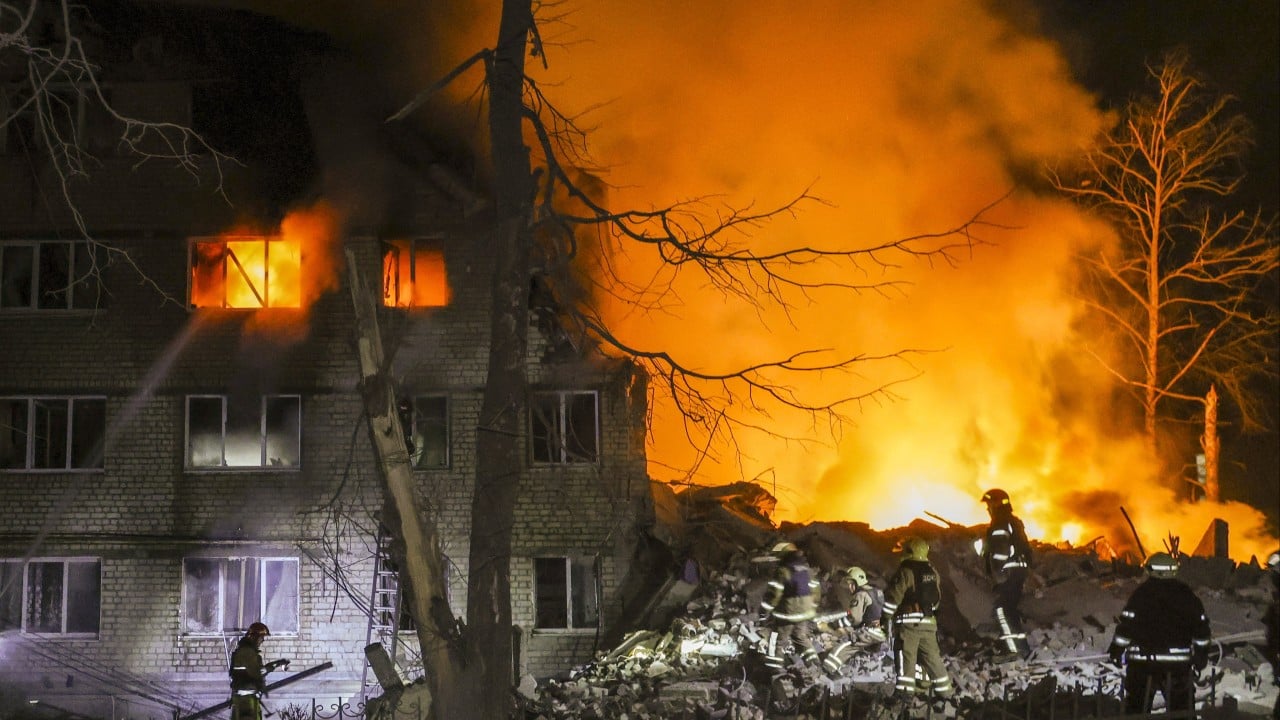
It wasn't a sound, actually. It was a physical displacement of reality. When a Russian Kh-59 or a repurposed S-300 missile strikes a residential block, the air doesn't just vibrate. It screams. It becomes a solid wall of pressure that tears the oxygen out of your lungs before the fire even finds you. In an instant, the ceiling of Oksana’s living room, the one she painted a soft eggshell white three years ago, ceased to exist.
It became the sky. A dark, smoke-choked, terrifyingly open sky.
The headlines will tell you that seven people died. They will list the numbers: twenty-one wounded, two children among them, one apartment block partially collapsed. These figures are clean. They fit into spreadsheets. They are the currency of "international concern."
But statistics are the armor we wear to keep from feeling the jagged edges of the truth. A statistic doesn't describe the smell of pulverized concrete, which is gray and alkaline and sticks to the back of your throat like wet wool. A statistic doesn't capture the specific, high-pitched ringing in the ears of a father who is currently digging through a pile of drywall and insulation, his fingernails bleeding, because he knows his daughter’s bed was right there.
Kharkiv is a city of echoes. Located just twenty-five miles from the Russian border, it has lived under the shadow of the "long reach" for years. It is a city where the inhabitants have developed a sixth sense for the whistle of incoming metal. They know the difference between the dull thud of an interceptor and the sickening, wet crunch of a direct hit.
Imagine your own home. Think of the kitchen table where you pay your bills. Think of the photograph on the mantle. Now, imagine a force so indifferent and so massive that it turns that table into toothpicks and that photograph into ash in less time than it takes to blink. This isn't "collateral damage." It is the systematic erasure of the domestic. It is a war against the very idea of safety.
The rescuers arrived within minutes. These men and women operate in a state of controlled desperation. They move through the "white lung" of the dust, their headlamps cutting weak yellow swathes through the gloom. They aren't looking for "at least seven." They are looking for the one. The one voice. The one scratch against a pipe. The one hand reaching out from beneath a slab of what used to be a balcony.
Consider the geometry of a collapse. When a missile hits the middle floors, the weight of the levels above creates what engineers call a "pancake effect." Voids are rare. Survival in those voids is a matter of centimeters. If you were leaning left to reach for a glass of water, you lived. If you were leaning right to pet the cat, you didn't.
Life, in these moments, is stripped of all its complexity and reduced to the most brutal, binary lottery imaginable.
Why Kharkiv? Why this specific building on a Friday night? The military analysts will talk about "degrading the morale of the civilian population" or "testing air defense density." They use these phrases to make the senseless feel strategic. They want us to believe there is a logic to the slaughter, a grand chessboard where these lives are mere pawns to be traded for a few meters of scorched earth.
But there is no logic in a child’s shoe lying on a sidewalk three blocks away from the blast site. There is no strategy in a grandmother losing her sight because the windows of her bedroom turned into a thousand glass needles.
The world watches this through a glass screen, scrolling past the carnage to find something more digestible. We have become experts at the "fast-forward" of human suffering. We see the smoke, we see the blue and yellow flags, and we feel a momentary pang of pity before we return to our own warm tea and our own intact ceilings.
But for the survivors in Kharkiv, there is no fast-forward. There is only the long, agonizing "now."
Now is the moment the adrenaline fades and the realization sets in that everything is gone. Not just the furniture, but the history. The birth certificates. The wedding albums. The heirlooms that were supposed to be passed down through generations. These are the "invisible stakes." This is the cultural and personal bankruptcy that follows the physical destruction. When you blow up an apartment building, you aren't just killing people; you are murdering the future they were supposed to have.
The tragedy of the "seven killed" is that we will forget their names by Tuesday. We will wait for the next strike, the next number, the next headline to replace this one. We have turned the agony of Ukraine into a weather report—grim, predictable, and ultimately ignored until the storm hits our own porch.
The people of Kharkiv don't have the luxury of looking away. They are currently standing in the mud and the glass, watching the cranes lift the heavy pieces of their neighbors' lives into the air. They are waiting for the sirens to start again. They know that as long as the sky is open, it is no longer a source of light. It is a source of death.
In the wreckage of 4C, the tea has finally gone cold. The pot is likely shattered, its porcelain mixed with the dust of the walls. The woman who lived there is no longer a woman to the world; she is a data point in a "competitor’s article," a digit in a death toll that is already being updated.
But in the silence of the night, if you listen past the sirens and the shouting, you can hear the real story. It’s the sound of a city refusing to break, even as its bones are crushed. It’s the sound of people who know that even when the ceiling becomes the sky, they still have to find a way to breathe.
They are still digging. They are still hoping for a voice in the dark. They are still human, even when the world treats them like debris.
The rubble is still cooling. The shadows of the survivors are long and jagged against the ruins. Somewhere in the distance, a dog is barking at a moon that shouldn't be visible through the roof of a bedroom.