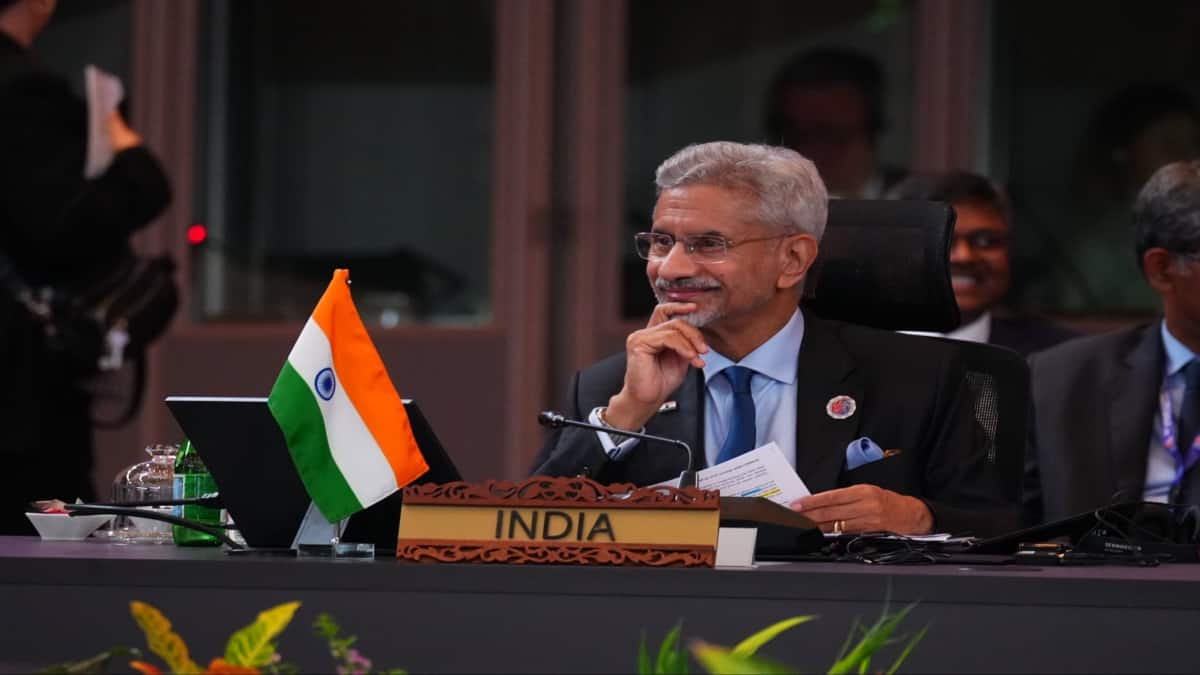
India has transitioned from a regional player to the self-appointed custodian of the Indian Ocean. External Affairs Minister S. Jaishankar recently underscored this by labeling the nation a "net security provider," but the phrase carries more weight than diplomatic boilerplate usually allows. It means New Delhi is now the primary responder for maritime piracy, medical emergencies, and natural disasters across a massive stretch of water. However, the ground reality is a messy mix of aging naval hardware, aggressive Chinese encroachment, and a neighborly suspicion that no amount of soft power can fully erase.
The Indian Navy currently operates in a permanent state of high-alert friction. While the rhetoric suggests a smooth projection of authority, the actual execution involves balancing limited resources against an expanding list of threats. To be a net security provider, a country must have the surplus capacity to protect others. India is finding that this capacity is being tested by a "polycrisis" of traditional state competition and unconventional maritime crime.
The Strategy of First Response
Being the first on the scene is not just about altruism. It is about territorial signaling. When an Indian destroyer thwarts a pirate hijacking off the coast of Somalia, it sends a message to both the criminals and the global powers watching from the sidelines. The message is simple: This is our backyard, and we have the reach to police it.
This reach is increasingly facilitated by a sophisticated Information Fusion Centre for the Indian Ocean Region (IFC-IOR). Located in Gurugram, this hub acts as the brain for regional maritime awareness. It pulls data from coastal radar chains, satellite imagery, and "white shipping" agreements with dozens of countries. By sharing this data, India creates a dependency. Smaller nations like Mauritius, Seychelles, and Sri Lanka begin to rely on New Delhi’s eyes and ears. This dependency is the truest form of "net security." It is less about firing missiles and more about owning the map.
Yet, the digital map does not always match the physical one. The Indian Ocean is a graveyard for idealistic foreign policy. While India provides the security "net," China provides the infrastructure "debt." This creates a recurring tension where India saves a ship from pirates, but the port that ship returns to is owned by a Chinese state-backed firm.
The Chinese Shadow and the Port Problem
China’s "String of Pearls" is no longer a theoretical threat; it is a logistical reality. From Gwadar in Pakistan to Hambantota in Sri Lanka and Kyaukpyu in Myanmar, Beijing has secured a ring of strategic outposts. These are not officially military bases, but the distinction is becoming irrelevant. Dual-use facilities allow Chinese research vessels—widely suspected to be spy ships—to dock, refit, and monitor Indian naval movements.
India’s response has been a frantic game of geopolitical catch-up. New Delhi has ramped up its own "necklace of diamonds" strategy, securing access to ports like Duqm in Oman and Agaléga in Mauritius. But there is a massive disparity in spending. China’s naval expansion is the fastest the world has seen since World War II. India is trying to match a blue-water titan with a budget that is often bogged down by bureaucratic procurement delays and a heavy reliance on domestic manufacturing that hasn't yet hit its stride.
The "ground realities" Jaishankar mentions are likely an admission of this lopsided race. India cannot outspend China. It must outmaneuver them through partnerships. This is why the Quad—comprising India, the US, Japan, and Australia—is the silent engine behind India’s maritime confidence. India provides the local boots on the ground (or boots on the deck), while the allies provide the high-end technology and deep-pocketed financing.
Hard Hardware and the Aging Fleet
A net security provider is only as good as its hull count. The Indian Navy has a stated goal of becoming a 175-ship force by 2035. Currently, it sits significantly lower, and the composition of that fleet is a point of internal debate.
The debate centers on the aircraft carrier. Proponents argue that a carrier is the ultimate symbol of a net security provider—a floating airfield that can project power thousands of miles from the mainland. Critics, however, point out that carriers are "big, slow targets" in an age of hypersonic missiles and cheap, lethal drones. They argue that India should instead invest in a massive fleet of conventional and nuclear-powered submarines to create an "anti-access/area denial" (A2/AD) zone that would make the Indian Ocean too dangerous for any hostile navy.
- INS Vikrant: India’s first indigenous carrier is a feat of engineering, but it still relies heavily on foreign aviation technology.
- Submarine Deficit: The underwater fleet is aging. The Project-75I program, aimed at building advanced diesel-electric submarines with Air-Independent Propulsion (AIP), has been mired in delays for a decade.
- Drone Warfare: The recent Houthi attacks in the Red Sea have shown that a $2,000 drone can tie up a billion-dollar destroyer. India is now rushing to integrate electronic warfare suites and directed-energy weapons across the fleet.
This hardware gap is the "reality" that tempered Jaishankar’s optimism. You cannot provide security if your ships are in the dry dock for repairs.
The Human Element and Humanitarian Diplomacy
India’s greatest advantage isn't its missiles; it is its location and its history. For centuries, Indian merchants, sailors, and scholars have traversed these waters. This cultural footprint is a form of "security" that China cannot buy.
When a cyclone hits Mozambique or a water crisis strikes the Maldives, Indian Navy ships are usually the first to arrive with food, water, and medical teams. This "Mission SAGAR" (Security and Growth for All in the Region) isn't just a catchy acronym. It is a calculated move to position India as the "benign" power. Unlike the West, which is often seen as transactional, or China, which is seen as predatory, India positions itself as the "first responder" that stays in the neighborhood.
However, even this role is fraught. The "India Out" campaign in the Maldives showed how quickly a friendly neighbor can turn hostile when local politics are stoked by anti-India sentiment. Security is not just about stopping pirates; it is about maintaining political legitimacy in the eyes of smaller neighbors who fear being crushed between giants.
The New Front of Underwater Cables
Security in 2026 is not just about what floats on the surface. The Indian Ocean floor is a literal web of fiber-optic cables that carry the vast majority of the world’s data. If these cables are cut, global finance stops.
India has begun to take cable security seriously. The navy is developing specialized subsea capabilities to monitor and protect this infrastructure. This is a silent war. There are no explosions, just "accidental" anchor drags or mysterious submersible malfunctions. As a net security provider, India is now expected to guard the world's internet as much as its oil tankers.
This expands the definition of "ground realities." The "ground" is now the seabed. India's ability to monitor deep-sea activities is still in its infancy compared to the US or Russia, but it is a critical pillar of its claim to regional dominance.
The Cost of Professionalism
To maintain this status, the Indian Navy has had to adopt a grueling operational tempo. Ships are spending more days at sea than ever before. This places an immense strain on the sailors and the machines.
The navy is also navigating the "Agnipath" recruitment scheme, a controversial move to shorten service tenures to save on pension costs. In a high-tech naval environment, where specialized skills take years to master, the four-year "Agniveer" model is a gamble. If the human element fails, the most advanced stealth frigate becomes a liability.
India’s quest to be the primary guardian of the Indian Ocean is a high-stakes play for global relevance. It is a role born of necessity—no one else is going to protect India’s interests for it. But to succeed, the nation must bridge the gap between its soaring diplomatic rhetoric and the gritty, expensive reality of maintaining a world-class fleet in a crowded sea.
The next time you see a headline about an Indian ship rescuing a crew in the Gulf of Aden, understand it isn't just a rescue. It is a payment on a very expensive insurance policy for the nation's future.
Identify the specific naval assets currently stationed in the Arabian Sea to better understand the immediate tactical reach of this security net.