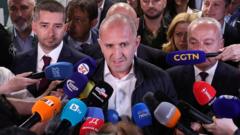
Bulgaria has been stuck in a loop for five years. Since 2021, the country has staggered through seven failed elections, countless caretaker cabinets, and a political class that seemed more interested in bickering than governing. On April 19, 2026, the cycle finally broke—or at least, it shifted into a completely new, and potentially more dangerous, gear.
Rumen Radev, the former fighter pilot who walked away from the presidency in January to get his hands dirty in party politics, didn't just win. He dominated. Exit polls show his Progressive Bulgaria (PB) party pulling in a massive 38.1% of the vote, leaving his rivals in the dust. His closest competitor, Boyko Borissov’s GERB, is limping behind at roughly 15%.
If you're looking for the reason why a nation once seen as a stable, if corrupt, NATO and EU member just handed the keys to a man who openly winks at Moscow, you've to look at the December 2025 protests. People didn't just want a new face. They wanted a hammer. Radev convinced them he’s that hammer.
The End of the Perpetual Crisis
Bulgarians are tired. You can see it in the turnout numbers, which actually ticked up this time because there was finally a "new" option that felt powerful enough to end the stalemate. For years, the country was split between the old guard of GERB and the reformist "We Continue the Change" (PP-DB) bloc. Neither could ever get enough leverage to keep a government alive for more than a few months.
Radev stepped into that vacuum with a very specific pitch: he's the only one strong enough to clear out the "oligarchic model." It's a classic strongman move. He took the energy from the anti-corruption protests and channeled it into a nationalist-tinged, center-left platform that promises to put "the economy before ideology."
Russia and the Orbán Comparison
Let's be real about the elephant in the room. Radev’s victory isn't just a domestic shift; it’s a geopolitical headache for Brussels. While Bulgaria officially joined the eurozone earlier this year, Radev’s rhetoric has been anything but "standard EU." He’s criticized the defense agreements with Ukraine, opposed sending weapons to Kyiv, and suggested that Bulgaria needs to reopen dialogue with Russia for the sake of energy security.
Critics are already calling him a "moderate Orbán." There’s a fear that he’ll use this mandate to steer Sofia away from its Western commitments.
- The Pro-Russia Stance: Radev argues for "practical relations" with Moscow.
- The Cultural Pivot: He’s leaned into social conservatism, attacking "liberal ideology" and the Green Deal.
- The Sovereignty Argument: He frames his moves as putting Bulgarian interests first, even if it irritates NATO allies.
But don't assume he’s a Kremlin puppet just yet. Analysts suggest he might just be playing a balancing act to keep his populist base happy. Governing is a lot harder than campaigning, and Bulgaria’s economy is now deeply tied to the euro. He can’t just flip the table without consequences.
Can He Actually Form a Government
Winning 38% is huge in a proportional system, but it’s not a majority. Radev needs 121 seats to rule, and right now he's looking at a few options.
He's already ruled out working with Borissov or the sanctioned Delyan Peevski. That leaves him looking toward the reformists of PP-DB, who came in third with 14%. But there’s a massive bridge to gap there. The reformists are staunchly pro-Western and pro-Ukraine. They might help him fight corruption, but they won’t help him cozy up to Putin.
If that fails, he might look to the nationalists in the "Revival" party or the Socialists. That would be a government that looks very different from anything Sofia has seen in decades—one that is decidedly more skeptical of the EU's current direction.
What This Means for You
If you’re watching the markets or the Balkan political scene, pay attention to the next 48 hours. The official results will drop on Monday, and the horse-trading starts immediately after.
- Watch the Coalition Talks: If Radev picks the reformists (PP-DB), expect a push for judicial reform but a continued pro-EU foreign policy.
- Monitor Energy Policy: If he moves toward "Revival," look for a pivot in how Bulgaria handles Russian gas and nuclear energy projects.
- The Eurozone Stability: Bulgaria just got in; the last thing the ECB wants is a populist leader making noise about fiscal sovereignty.
Bulgaria has traded its political deadlock for a high-stakes experiment. Whether Radev is the "cleaner" he claims to be or just another populist with a pilot's license remains to be seen. Honestly, for most Bulgarians tonight, they’re just happy they might not have to vote again in three months.
Keep an eye on the official tally from the Central Election Commission tomorrow morning. That’s when the real math of power begins.