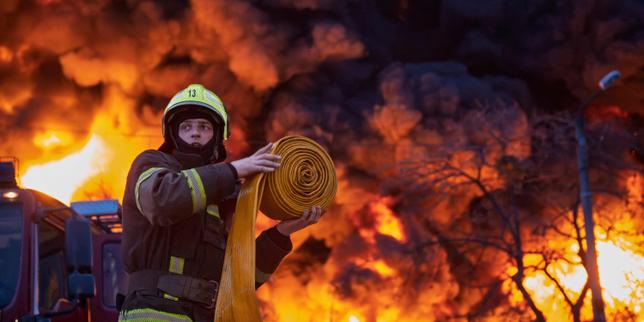
Western media is addicted to the visual pornography of ruin. Every time a Russian missile hits a residential block in Kyiv or a market in Kostiantynivka, the cycle repeats. You get the 4K drone footage of smoke, the tally of the dead—17 today, 115 wounded—and the immediate pivot to "barbarism" as a strategic explanation. It is an emotional loop that serves to obscure the cold, mechanical reality of 21st-century warfare.
Stop looking at the craters. Start looking at the industrial production curves.
The "lazy consensus" suggests that these strikes are signs of Russian desperation or a purely psychological campaign designed to break Ukrainian morale. This is a comforting lie. It implies that if the West just sends more "thoughts and prayers" or another battery of Patriots, the terror stops. In reality, these strikes are part of a calculated, multi-vectored depletion strategy. We are witnessing the first war of pure attrition in the digital age, and we are misreading the data points because we are too focused on the tragedy of the individual casualty.
The Myth of Precision as a Moral Arbiter
We have been conditioned by the Gulf War and subsequent "clean" interventions to believe that missiles are either surgical or failed. When a Russian Kh-101 hits a civilian apartment, the immediate analysis is that Russia "missed" or is "targeting civilians for terror."
While terror is a byproduct, the technical reality is often more sinister. Russia is utilizing a high-low mix of munitions—ancient Soviet-era Kh-22s alongside modern, terrain-matching cruise missiles—to force Ukraine into a "negative cost-exchange ratio."
Every time a $20,000 Shahed drone forces Ukraine to fire a $2 million interceptor, the math moves toward a Russian victory. We celebrate the "90% interception rate" reported by the Ukrainian Air Force without acknowledging that the 10% that get through are often the result of a deliberate saturation of the sensor net. The 17 dead are a tragedy; the 500 interceptors exhausted over a month are a catastrophe. If you aren't talking about the interceptor inventory, you aren't talking about the war.
Morale is Not a Metric
I have spent years analyzing how kinetic action translates into political shifts. The prevailing narrative is that "bombing civilians only hardens their resolve."
History is more nuanced. Ask the residents of Mariupol or the refugees from Avdiivka if "hardened resolve" stopped the structural collapse of their cities. Morale matters until the lights go out and the water pumps stop permanently. By focusing on the "will to fight," analysts ignore the "physical capacity to exist."
Russia isn't trying to make Ukrainians give up; they are trying to make the territory uninhabitable. It is a siege of a nation, not just a city. When we frame these strikes as "failed attempts to break spirits," we ignore the fact that they are successfully dismantling the electrical and logistical backbone of a sovereign state. You cannot run a modern economy—or a modern army—on "resolve" alone. You need 220V.
The Intelligence Blind Spot
Why do the strikes continue to hit significant targets despite the supposed depletion of Russian "smart" chips? Because the sanctions regime is a sieve.
I’ve seen the manifests. Western components are still flowing through third-party intermediaries in Central Asia and the Caucasus. The "contrarian truth" here is that Russia has successfully transitioned to a war footing while the West remains in a "peace-time procurement" mindset.
- Russian Production: Currently estimated at 100+ long-range missiles per month.
- Western Supply: A fragmented, bureaucratic mess where it takes eighteen months to spin up a new production line for 155mm shells.
The headlines focus on the 17 dead because it's visceral. They should be focusing on the fact that Russia’s military-industrial complex is currently outproducing the combined output of several NATO members. We are bringing a spreadsheet to a gunfight.
The Failure of Visual Confirmation
In the digital age, we suffer from "OSINT bias." If there isn't a video of a tank exploding, it didn't happen. If there is a video of a civilian building on fire, it's the only thing that happened.
This creates a warped perception of the front line. Russia uses "maskirovka" (deception) in the information space just as much as on the battlefield. By allowing—and even encouraging—the distribution of images showing civilian damage, they mask the strikes that actually hit "boring" targets like rail switchyards, grain silos, and localized power substations.
We are being fed a curated diet of destruction that matches our moral expectations. Meanwhile, the structural integrity of the Ukrainian state is being gnawed away in the shadows where the cameras aren't pointed.
Stop Asking if Ukraine Can Win
The question "Can Ukraine win?" is the wrong question. It assumes a binary outcome based on 1945 standards. In the current landscape, "victory" is a sliding scale of functionality.
If Ukraine regains its borders but loses its entire youthful demographic and its energy independence, what has been won? If Russia continues to lose 1,000 men a day but maintains the industrial capacity to level a city every Tuesday, who is actually winning the war of attrition?
We need to stop treating these missile strikes as isolated "war crimes" to be logged in a ledger for a future Hague trial that may never happen. They are tactical maneuvers in a grand strategy of de-industrialization.
The High Cost of Selective Outrage
The West’s reaction to these images is predictable: a flurry of social media posts, a promise of a few more air defense systems "by the end of the year," and a return to the domestic news cycle. This is the ultimate victory for the aggressor.
By normalizing the "tragedy," we accept the attrition. We have become spectators in a Colosseum, nodding at the bravery of the gladiator while ignoring the fact that the lions are being fed by our own complacency.
The strategy isn't to win a single decisive battle. It is to make the cost of Ukrainian existence so high that the West eventually decides the "investment" is no longer yielding a return. It is cold. It is heartless. And it is working precisely because we refuse to see it for what it is.
The real story isn't the 17 dead. It’s the 1,000 missiles that didn't miss. It's the factories that will never reopen. It's the generation that will grow up in the dark because we were too busy counting bodies to count the kilovolts.
War is a logistics problem. Everything else is just PR.