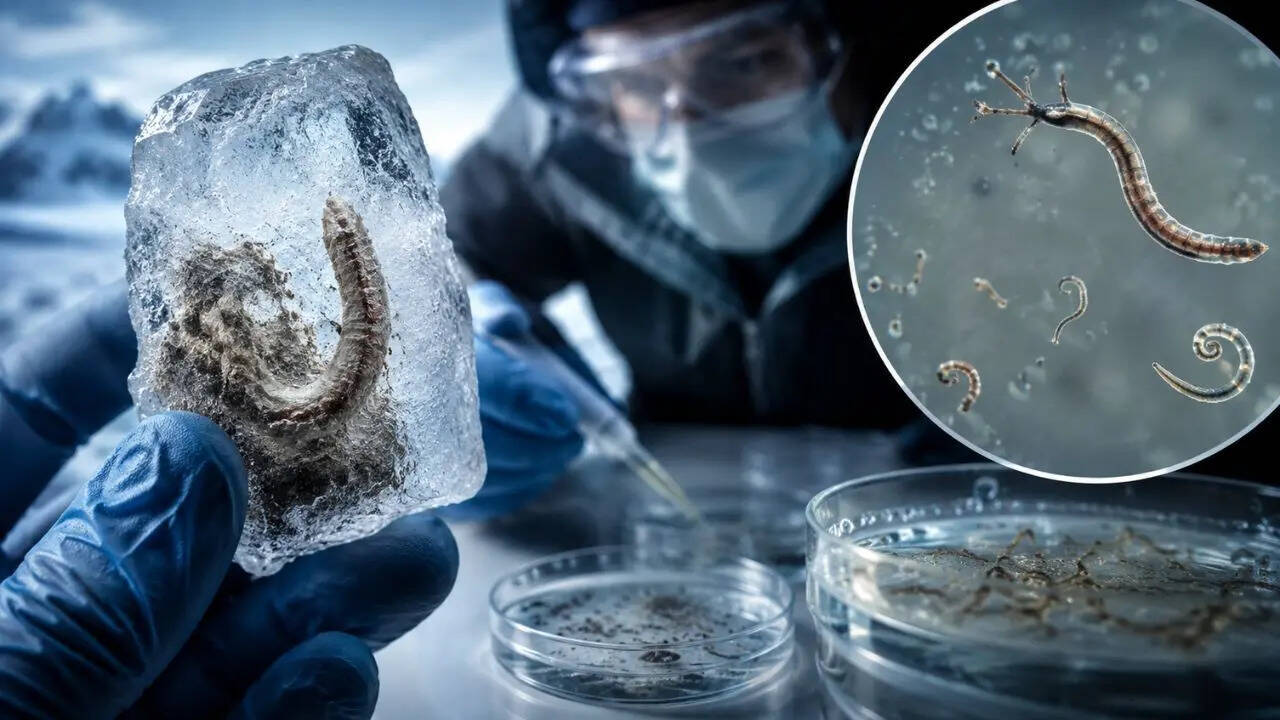
The discovery of a viable bdelloid rotifer in Siberian permafrost—dating back approximately 24,000 years—invalidates previous assumptions regarding the maximum duration of multicellular biological stasis. This is not a mere "revival" story; it is a proof of concept for high-fidelity biological data preservation over geological timescales. By successfully transitioning from a state of ametabolic dormancy (cryptobiosis) back into a reproductive cycle, this organism demonstrates a sophisticated physiological architecture designed to bypass the traditional entropy of cellular degradation.
Understanding this event requires a shift from viewing the rotifer as a "zombie" to viewing it as a high-integrity biological storage system. The ability of these microscopic, multicellular organisms to survive tens of millennia rests on three distinct physiological pillars: the mitigation of oxidative stress, the prevention of ice crystal-induced mechanical failure, and the stabilization of genomic integrity during prolonged desiccation.
The Mechanisms of Cryogenic Persistence
The primary threat to any organism stored at sub-zero temperatures for 24,000 years is the formation of ice crystals. Within a standard cellular environment, freezing causes water molecules to expand and form jagged structures that rupture cell membranes and denature proteins. The rotifer avoids this through a process of controlled dehydration and vitrification.
Cellular Vitrification and Glass Transition
As the surrounding permafrost cools, the rotifer enters a state known as anhydrobiosis. It replaces internal water with specific sugars, likely trehalose or similar disordered proteins, which act as cryoprotectants. This creates a "glassy" state within the cell. Unlike ice, which has a crystalline structure, this biological glass is amorphous. It lacks the sharp edges that puncture membranes, effectively locking the cellular machinery in a static, non-reactive matrix.
This state halts all measurable metabolic activity. In economic terms, the rotifer enters a zero-cost maintenance phase. It requires no caloric intake and produces no waste. The bottleneck for survival shifts from energy availability to the structural limits of the protective "glass."
DNA Repair and Integrity Maintenance
Even in a vitrified state, background radiation and chemical decay pose a constant threat to the genome. Over 24,000 years, the accumulation of double-strand breaks in DNA would typically render an organism non-viable upon rehydration. The rotifer’s survival suggests one of two possibilities:
- Passive Shielding: The molecular density of the vitrified state significantly reduces the movement of free radicals, minimizing the frequency of DNA lesions.
- Post-Thaw Orchestration: The organism possesses a hyper-efficient DNA repair suite that activates immediately upon rehydration. This system must identify and correct thousands of genetic errors before the first mitotic division can occur.
The fact that the revived rotifer immediately began reproducing via parthenogenesis (asexual reproduction) indicates that its germline remained functional throughout the duration of the deep freeze.
Quantifying the Scale of Biological Resilience
To put this 24,000-year window into perspective, we must compare it to existing benchmarks in cryopreservation. Most laboratory-grade cryopreservation of mammalian cells relies on liquid nitrogen storage ($−196°C$). The Siberian permafrost, however, fluctuates at significantly higher temperatures ($−10°C$ to $−15°C$).
The fact that a multicellular organism—complete with a nervous system, gut, and reproductive organs—survived at these "warm" freezing temperatures for millennia suggests that the internal stabilization mechanisms are far more robust than current human technology.
Structural Comparison: Unicellular vs. Multicellular Dormancy
While scientists have previously revived bacteria (unicellular) and mosses (non-animal) from older samples, the rotifer represents a leap in complexity. A bacterium is a single packet of data; a rotifer is a coordinated system of specialized tissues.
- Systemic Coordination: Every tissue type in the rotifer must simultaneously enter and exit cryptobiosis. If the gut vitrifies but the nervous system crystallizes, the organism is lost.
- Ametabolic Synchronization: The transition out of dormancy requires a precise sequence. Water must enter the cells, the glass must melt, and the metabolic engine must restart without triggering a massive burst of oxidative stress that would kill the organism instantly.
The success of the Siberian specimen proves that multicellularity is not an inherent barrier to extreme longevity. The limitation is not the number of cells, but the efficiency of the protective transition.
The Pathogen Risk Framework: Myth vs. Probability
The revival of ancient organisms frequently triggers concerns regarding "permafrost pathogens." Analyzing this risk requires a move away from cinematic tropes toward a probability-based model of ecological competition.
The likelihood of a 24,000-year-old organism causing a modern pandemic is mitigated by the Evolutionary Lag Factor. Pathogens evolve in tandem with their hosts. A virus or bacterium from the Pleistocene is optimized for a world that no longer exists. Modern immune systems, while not specifically "primed" for ancient threats, have undergone 24,000 years of iterative pressure that the dormant organism has missed.
The real risk lies in Ecological Displacement. If an ancient organism possesses a metabolic pathway or reproductive advantage that has been lost in modern lineages, it could theoretically outcompete contemporary counterparts. However, the rotifer in question belongs to a genus still common today. It is not an alien entity; it is an older version of a successful software package.
Practical Applications in Synthetic Cryobiology
The ability to induce and reverse cryptobiosis in multicellular animals has profound implications for long-haul logistics and medical science. If we can isolate the specific proteins responsible for the rotifer’s vitrification, we can apply those mechanisms to human organ preservation.
The Organ Banking Bottleneck
Currently, the viability of a human heart for transplant is measured in hours. This is a supply chain failure. By applying the rotifer’s vitrification logic, we could transition from a "just-in-time" delivery model for organs to a "warehousing" model.
- Thermal Stabilization: Developing synthetic analogs of rotifer disordered proteins to prevent ice formation in human tissue at $−20°C$.
- Oxidative Buffering: Integrating the rotifer’s post-thaw repair mechanisms to manage the "reperfusion injury" that occurs when oxygenated blood returns to a dormant organ.
Deep-Space Exploration
The constraints of human space travel are largely biological. Life support systems are heavy, energy-intensive, and prone to failure. If the human metabolic rate could be suppressed even by 50% using cryptobiotic-inspired techniques, the mass-to-orbit requirements for Mars missions would drop exponentially. The rotifer serves as the biological blueprint for this type of metabolic suspension.
Evaluating the Permafrost as a Biological Archive
The Siberian permafrost is often described as a "time capsule," but this is a technical misnomer. It is an active, albeit slow-motion, chemical environment. The depth at which the rotifer was found (3.5 meters) protects it from surface-level temperature fluctuations but exposes it to geothermal heat and seismic pressure.
The preservation of this specimen indicates that the permafrost's physical properties are conducive to maintaining biological "cold-storage" far longer than previously modeled. This suggests that the permafrost contains a massive, untapped library of genetic information from the Pleistocene.
Accessing this library allows us to study the "Evolutionary Trajectory" of species. By comparing the genome of the 24,000-year-old rotifer to its modern descendants, we can identify which genes have been conserved and which have been discarded. This provides a direct look at the "source code" of adaptation.
Strategic Implications for Environmental Management
The thawing of the Siberian permafrost is not just a climate event; it is a data-loss event. As the permafrost melts, the vitrified organisms within it rehydrate. Without the immediate intervention of a laboratory environment, most of these organisms will die or be consumed by modern predators, erasing thousands of years of biological history.
The strategic priority must be the Systematic Bio-Prospecting of permafrost zones.
- Mapping High-Probability Zones: Identifying areas with stable thermal histories that are most likely to contain viable multicellular organisms.
- Developing Rapid Rehydration Protocols: Creating standardized methods to wake these organisms without damaging their cellular structures.
- Genomic Sequencing at Scale: Creating a digital backup of every revived organism to ensure that even if the specimen dies, the genetic data is preserved.
The 24,000-year-old rotifer is a signal in the noise. It tells us that life is not nearly as fragile as our current medical models suggest. The durability of the bdelloid rotifer is a benchmark for what is possible when an organism masters the physics of the phase transition. We are now tasked with reverse-engineering that mastery to extend the shelf-life of biological systems, from the cellular level to the entire organism.