Stop looking for a face. You are being played.
Every few months, a new "definitive" theory emerges claiming to have finally unmasked Banksy. The latest frenzy stems from his 2022 trip to Ukraine. Journalists and amateur sleuths pored over CCTV footage and logistics, convinced that a grainy image of a man in a mask or a specific travel itinerary would finally end the greatest mystery in modern art.
They think they are solving a puzzle. In reality, they are falling for the very commercial trap Banksy’s work supposedly critiques. The hunt for his "true identity" isn't investigative journalism; it’s a desperate attempt to turn a systemic critique into a celebrity profile.
By focusing on whether the man behind the stencil is Robin Gunningham, Robert Del Naja, or a committee of Bristolian street artists, the public conveniently ignores the most uncomfortable truth: Banksy is no longer a person. Banksy is a high-yield asset class.
The Ukraine Trip was a Brand Activation
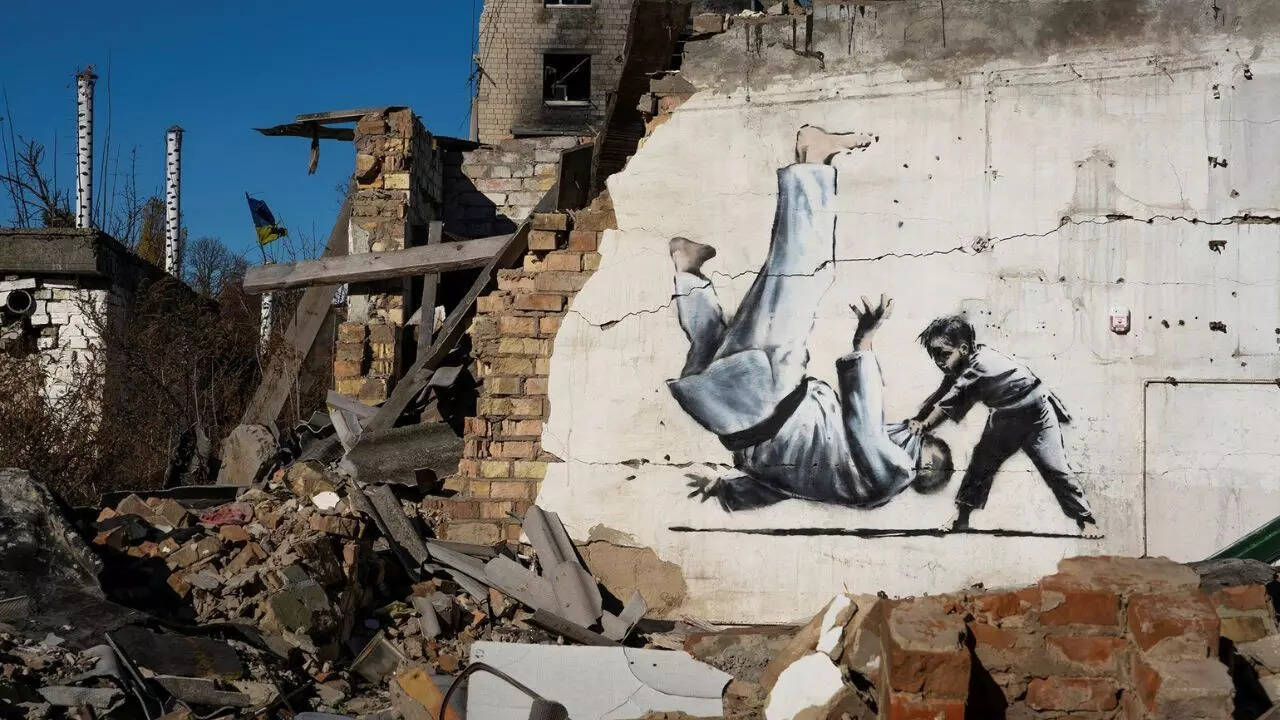
The narrative suggests that the Ukraine murals—stenciled on the ruins of bombed buildings—were a moment of raw, vulnerable activism where the artist finally slipped up. This is nonsense.
If you have spent any time in the high-stakes world of international art logistics, you know that flying into a conflict zone to produce multiple synchronized works across different cities isn't a "slip-up." It is a sophisticated military-grade operation. You don't "accidentally" get caught on camera when you’re operating at that level of tactical precision.
The "leaks" and "sightings" are part of the product. Anonymity is not a shield for Banksy; it is his primary marketing engine. Every time a tabloid claims to have "unravelled" the mystery, the valuation of his existing works spikes.
We are witnessing the gamification of art history. The media treats the search for his identity like a true-crime podcast, which successfully distracts everyone from the fact that his "anti-capitalist" art is now traded by the very hedge fund managers he mocks. If his identity were revealed tomorrow, the mystery premium would evaporate. The brand would be forced to survive on the merit of the art alone—and frankly, many in the secondary market aren't sure it could.
The Myth of the Lone Genius
The biggest misconception fueled by the Ukraine coverage is the idea of the "lone artist" venturing into the dark.
I have seen how these large-scale "guerrilla" installations work. They require scouts, drivers, fixers, and legal teams. When a mural appears on a wall in a war zone, it isn't just one guy with a backpack and a dream. It is a collective effort.
The obsession with finding "The One" is a symptom of our inability to understand decentralized influence. We are obsessed with the "Great Man Theory" of history. We want a singular hero (or villain) to pin the work on because the alternative—that "Banksy" is a corporate entity with a supply chain—is too boring to sell newspapers.
People ask: "Is Banksy actually a team?"
The answer is: It doesn't matter. Whether it's one man or a dozen, the output is a curated corporate identity. Treating the identity as a "secret to be revealed" is like trying to find the "real" Mickey Mouse. There is no real Mickey. There is only the mouse.
Why the Reveal Would Fail
Imagine a scenario where a DNA test proves once and for all that Banksy is a middle-aged man named Robin from Bristol.
What changes?
- The art doesn't become more profound.
- The political messages don't become more biting.
- The stencil of a rat holding a sign doesn't suddenly gain more aesthetic depth.
In fact, the work becomes less effective. Currently, Banksy functions as a mirror. Because he has no face, he can represent whatever the viewer wants him to be: a rebel, a prankster, a voice for the voiceless. The moment he has a face, he has a tax bracket, a political affiliation, and a personal history that can be scrutinized and "cancelled."
The anonymity is a strategic necessity for the art's survival in a hyper-partisan world. By remaining a ghost, he avoids the baggage of being a human. He stays a symbol.
The Hypocrisy of the Hunt
The most exhausting part of the "Identity Unravelled" discourse is the feigned moral high ground of the investigators. They claim they are "giving credit where it's due" or "documenting history."
Let’s be honest. They want to kill the magic to feel clever.
The art world is built on scarcity and exclusivity. Banksy flipped that by making his work public and free—at least initially. The public responded by trying to imprison him in a biography. We claim to hate the surveillance state, yet we use the tools of that state—geotagging, facial recognition, and data mining—to stalk an artist who explicitly asked to be left alone.
The Artist is a Reflection of You
Who cares who Banksy is?
The person isn't the point. The point is the reaction. The reaction to the Ukraine murals was a masterclass in how we consume "tragedy" through a lens of curated cool. People traveled hundreds of miles to take selfies with the rubble of someone's home just because a famous ghost painted on it.
That is the true mystery. Not "who is Banksy," but "why are we so broken that we need a celebrity stencil to care about a war zone?"
Banksy's greatest achievement isn't a mural in a bunker or a self-shredding frame. It's the fact that he's still living in your head, rent-free, without a passport photo.
The next time someone claims to have found him, or that his trip to Ukraine "unravelled" his identity, ask yourself: Why do you want to know? What do you gain? Because the moment you find him, the Banksy you care about is dead.
Stop looking.
The mystery is the work.
The face is just a distraction for people who don't know how to look at art.