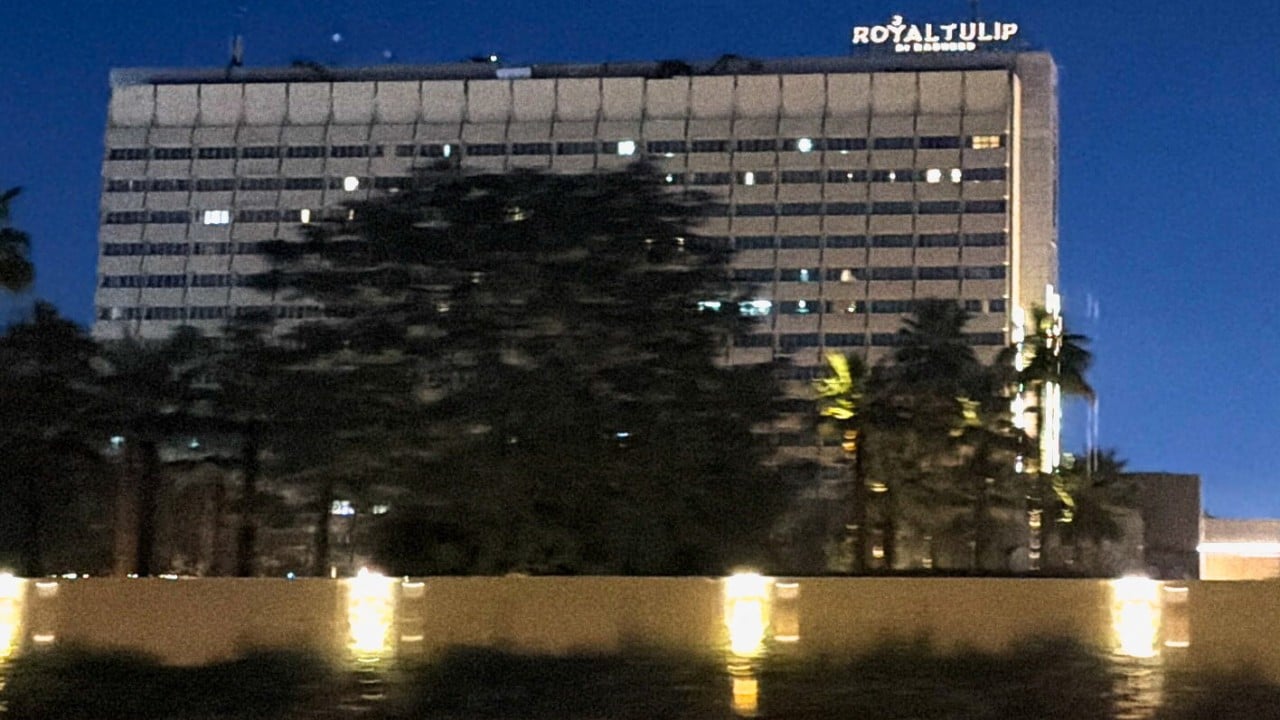
The explosion that rocked the Al-Rasheed Hotel earlier today did more than shatter reinforced glass in Baghdad’s high-security district. It effectively ended the era where physical walls and checkpoints defined safety for foreign diplomats and investors in Iraq. While early reports focus on the immediate damage to the luxury site, the real story lies in the calculated failure of the multi-million dollar defense grid designed to protect the very heart of Iraqi sovereignty.
A fixed-wing suicide drone, or loitering munition, bypassed the C-RAM (Counter Rocket, Artillery, and Mortar) systems specifically positioned to guard the nearby US Embassy complex. This was not a random act of desperation. It was a surgical strike intended to prove that the "Green Zone" is now a misnomer. By hitting a high-profile civilian landmark rather than a fortified military bunker, the attackers signaled a shift in strategy. They are targeting the confidence of the international community, making it clear that no amount of concrete can stop a $500 piece of technology guided by a consumer-grade GPS.
The Architecture of a Failed Perimeter
For two decades, the Green Zone has existed as a city within a city. It is a labyrinth of T-walls, blast-proof barriers, and biometric scanners. However, these defenses were built for the threats of 2006—truck bombs, snipers, and unguided Katyusha rockets. The modern threat is three-dimensional and increasingly silent.
The drone used in the hotel strike likely launched from a suburban backyard less than ten kilometers away. These devices have a low radar cross-section, often appearing no different from a large bird on aging detection systems. By flying at a low altitude and following the natural contour of the urban skyline, the aircraft remained invisible to the embassy’s primary sensors until it was too late to intercept.
Defensive systems like the Phalanx CIWS are incredibly effective against projectiles with a predictable ballistic arc. They are significantly less effective against a small, plastic-bodied drone that can change its flight path mid-air. When the "incoming" siren sounded today, it was a formality. The drone was already inside the perimeter.
The Business of Targeted Instability
The Al-Rasheed is not just a hotel. It is the primary residence for foreign business delegations and oil executives. By striking this specific target, the perpetrators are hitting Iraq where it hurts most—its attempt to normalize relations with global markets.
Iraq is currently trying to move away from its image as a perpetual war zone to attract foreign direct investment. You cannot attract a French energy firm or a Korean construction giant when their executives are being extracted from a burning hotel lobby. This strike serves as a veto on Iraqi progress. It tells the world that the militias and non-state actors still hold the final say over who is safe in the capital.
The timing is equally deliberate. It follows a series of legislative debates regarding the presence of foreign military advisors. Every time the Iraqi government moves toward a more centralized, state-controlled security apparatus, a "mystery" drone appears to remind everyone that the central government is not actually in control.
The Failure of Intelligence and the Rise of the Kit Drone
We have to stop calling these "advanced" weapons. That implies a level of state-level sophistication that makes the problem feel manageable through traditional diplomacy. In reality, these are "kit" drones. They are assembled from parts ordered on the open market, powered by engines meant for high-end RC planes, and triggered by simple servos.
The intelligence failure here isn't just about missing a launch; it’s about failing to track the supply chain of these components. Despite heavy sanctions and monitoring, the parts required to build a lethal loitering munition are flowing into Baghdad daily. They arrive in crates labeled as medical equipment or electronics for the consumer market.
Traditional counter-terrorism focuses on the person holding the trigger. Modern counter-terrorism must focus on the person holding the soldering iron. We are seeing a democratization of airpower that the West is fundamentally unprepared to counter in a dense urban environment. You cannot fire a 20mm cannon into a crowded neighborhood to take out a drone the size of a pizza box without causing the very collateral damage the attackers want.
The Myth of Neutrality in the International Zone
For years, there has been a quiet understanding that certain areas were "off-limits" to prevent total diplomatic collapse. The strike on the Al-Rasheed suggests that the rules of engagement have been rewritten. There is no longer a neutral ground.
If a luxury hotel situated between the Prime Minister’s office and the US Embassy can be hit with such precision, every other building in the district is a potential target. This creates a psychological toll on the personnel living there. It is a slow-motion siege. You don't need to win a battle if you can make the enemy’s daily life so precarious that they eventually choose to leave on their own.
We are seeing the results of a "gray zone" conflict where the attackers can deny involvement while reaping the strategic benefits. The official statements from the Iraqi military will promise an investigation, and they will likely find a charred launch frame in a vacant lot. But they won't find the pilots. They won't find the financiers.
Redefining the Defense Grid
If the Green Zone is to survive as a functional diplomatic hub, the approach to security must be rebuilt from the ground up.
- Electronic Warfare Integration: Relying on kinetic interception (shooting things down) is no longer sufficient. The perimeter needs a persistent "bubble" of signal jamming that can sever the link between a drone and its operator or spoof its GPS coordinates.
- Acoustic Detection Arrays: Since these drones are often too small for radar, defense forces must deploy sensitive microphone arrays that can identify the specific "whine" of a drone motor miles away.
- Supply Chain Interdiction: There must be a more aggressive move to track the import of specific high-performance brushless motors and flight controllers into the country.
The hotel strike is a warning shot for every major city in the Middle East, not just Baghdad. The technology used today will be more refined tomorrow. It will be faster, quieter, and capable of carrying a larger payload. The walls in Baghdad didn't fail because they were weak; they failed because they were irrelevant.
Security planners need to stop looking at the gates and start looking at the sky. If the Al-Rasheed can be turned into a target at the whim of a local militia with a laptop, then the Green Zone is no longer a sanctuary. It is a cage.
Verify the origin of the flight controller recovered from the site. Follow the serial numbers back to the shell companies in Dubai and Istanbul. That is the only way to find the real architects of this attack.

.jpg?width=1200&auto=webp&trim=0%2C100%2C0%2C100)