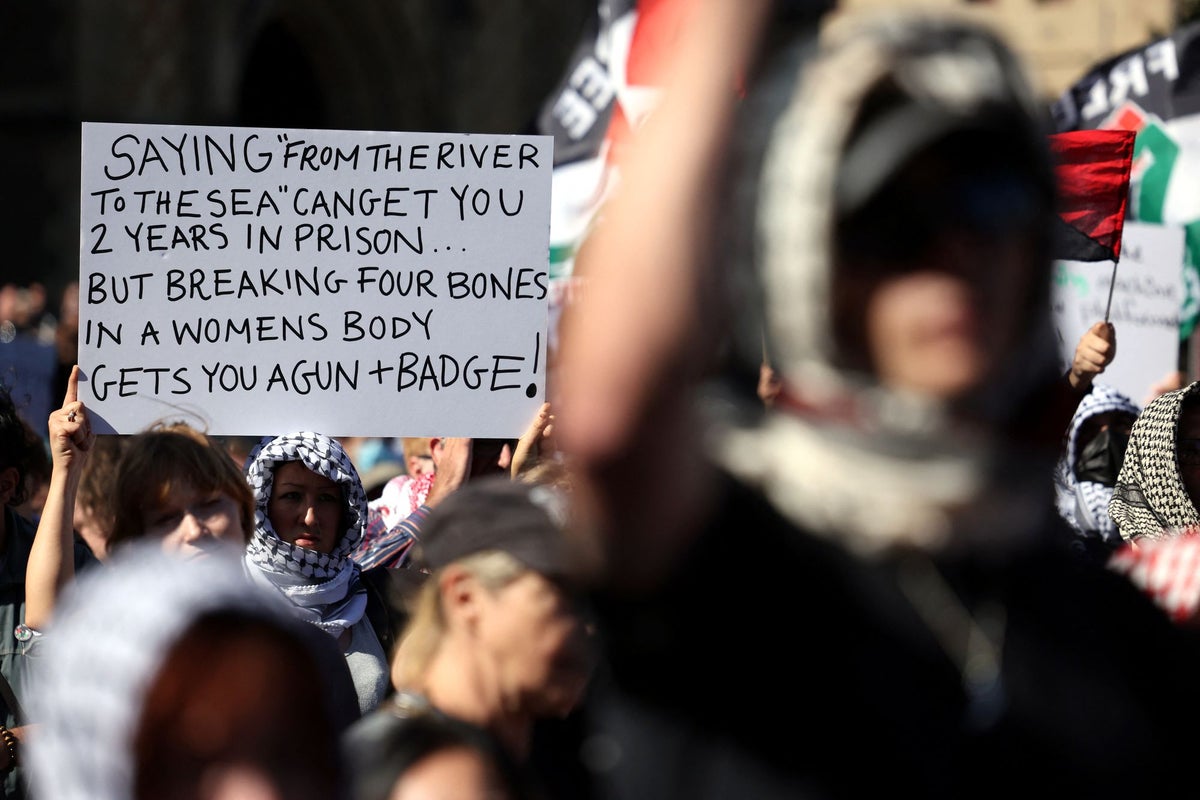
The hand-wringing over Australia’s proposed hate speech reforms has reached a fever pitch. On one side, you have the government claiming they are building a "safer digital town square." On the other, civil liberties groups and Palestine advocates are screaming that this is the death knell for political dissent.
They are both wrong. Learn more on a similar topic: this related article.
The lazy consensus suggests that stricter hate speech laws lead to a "crackdown" on advocacy. This narrative assumes that the law is a precise scalpel that will successfully silence specific movements. In reality, these laws are a blunt instrument that historically fuels the exact fires they intend to douse. If you are an advocate for a controversial cause, these laws aren't your cage; they are your megaphone.
The Martyrdom Loophole
Most critics of the legislation focus on the fear of being silenced. They miss the tactical advantage of being "suppressed." More reporting by The Washington Post explores similar views on this issue.
I have watched political movements across the globe—from the gilets jaunes in France to digital activists in the UK—utilize hate speech prosecutions as a recruitment tool. When a state moves to criminalize speech, it grants that speech a level of "forbidden fruit" status that no marketing budget can buy.
By framing Palestine advocacy as a target of these laws, activists aren't losing ground; they are gaining moral high ground. The moment a government labels a protest slogan as "hate speech," they transform a political argument into a battle for fundamental human rights. For a movement that thrives on highlighting systemic oppression, being "oppressed" by domestic law is a tactical win.
The Fallacy of the Neutral Algorithm
The competitor narrative suggests that these laws will be used to target Pro-Palestine voices specifically. This ignores the structural incompetence of legislative enforcement.
Australia’s proposed changes aren't about a targeted strike; they are about offloading the burden of "safety" onto Big Tech. When you pass laws that threaten social media platforms with massive fines for failing to remove "harmful" content, you don't get precise moderation. You get over-moderation.
The bots don't care about your geopolitical nuances. They care about avoiding a $50 million fine.
- Scenario A: A platform allows a heated debate on Gaza. It risks a massive fine if a single comment crosses an arbitrary line.
- Scenario B: A platform nukes the entire discussion thread. It loses some user engagement but gains total legal immunity.
Platforms will always choose Scenario B. This isn't a "crackdown on Palestine advocacy"—it’s a wholesale lobotomy of the Australian internet. The irony is that the more "protected" the government tries to make the public, the more they insulate people from the reality of global conflict.
Misunderstanding "Harm"
The current debate rests on a flawed definition of harm. The government wants to legislate against "vilification" and "hostility." These are subjective, shifting goalposts.
In a professional setting, I’ve seen legal teams struggle to define "offensive" in a way that survives a week of cultural shifts. What was considered "advocacy" on Monday is labeled "hate speech" by Friday because of a trending hashtag or a shift in the news cycle.
When you codify subjectivity, you don't protect minorities; you protect the status quo. If these laws pass, they won't just be used against Palestine advocates. They will be used by anyone with enough legal capital to claim they feel "vilified."
Imagine a scenario where a mining corporation claims that environmental activists are "inciting hostility" against their workers. Under a broad interpretation of hate speech and vilification, the legal framework exists to silence them. The "Palestine crackdown" is just the tip of a very large, very corporate iceberg.
The Streisand Effect on Steroids
The "Streisand Effect" is a well-documented phenomenon where the attempt to hide or remove a piece of information has the unintended consequence of publicizing it more widely.
When the Australian government tries to scrub "hateful" rhetoric from the web, they ensure that rhetoric goes viral. Digital spaces are not like physical town squares. You cannot "clear" a digital park. You only push the conversation into encrypted channels like Telegram or Signal, where it becomes more radicalized, less moderated, and far more dangerous.
By pushing advocacy out of the "safe" digital town square, the government is effectively ending their ability to monitor it. They are trading visible tension for invisible radicalization. It is a catastrophic trade.
The Data Gap
The competitor's article relies on the "fear" of advocates. Let’s look at the data of similar laws in Europe.
In Germany, the Network Enforcement Act (NetzDG) was designed to curb hate speech. Since its inception, political polarization has not decreased. In fact, the far-right has grown in strength, using the "censorship" narrative to radicalize voters who feel the "establishment" is silencing them.
Australia is following a failed blueprint.
- Legislate: Create vague definitions of hate.
- Enforce: Force platforms to censor broadly to avoid fines.
- Backfire: Create a vacuum where the "censored" voices become heroes of free speech.
- Polarize: The middle ground disappears as people pick sides based on who is being silenced.
Why Advocates Should Stop Whining
If you believe your cause is just, you shouldn't fear these laws. You should exploit them.
History shows that the most effective way to dismantle a bad law is to let the state enforce it poorly. Every time an advocate is hauled before a tribunal for a tweet, the legitimacy of the law shrinks. The "crackdown" is not a wall; it is a stage.
The real danger isn't that you'll be silenced. The real danger is that you'll become so obsessed with the "right to speak" that you'll forget how to actually make a point.
The Myth of the Safe Space
We have been sold the lie that a "safe" internet is one where nobody is offended. This is a biological and sociological impossibility.
Conflict is the primary driver of political change. By attempting to legislate away "hostility," the Australian government is attempting to legislate away the very mechanism of progress. You cannot have advocacy without hostility toward the status quo. You cannot have "Palestine advocacy" without being hostile to the policies of the Israeli government.
If the law forbids hostility, it forbids advocacy.
But here is the counter-intuitive truth: The state is too weak to actually stop it. They are passing these laws to give the illusion of control. They want the public to feel protected and the advocates to feel scared.
Don't give them the satisfaction.
Stop asking the government to "clarify" the laws. Stop asking for "carve-outs" for political speech. A carve-out is just a cage with a different name.
The strategy for activists isn't to fight the law in the courts; it's to make the law unenforceable through sheer volume. If everyone is a "hater" under the law, then nobody is.
Australia isn't entering an era of silence. It’s entering an era of performative litigation where the only winners are the lawyers and the only losers are the citizens who still believe the government can protect their feelings.
The laws are coming. The crackdown is a fantasy. The chaos is the only thing that's real.
Buckle up. Over-moderation is the new censorship, and your "safety" is the casualty.