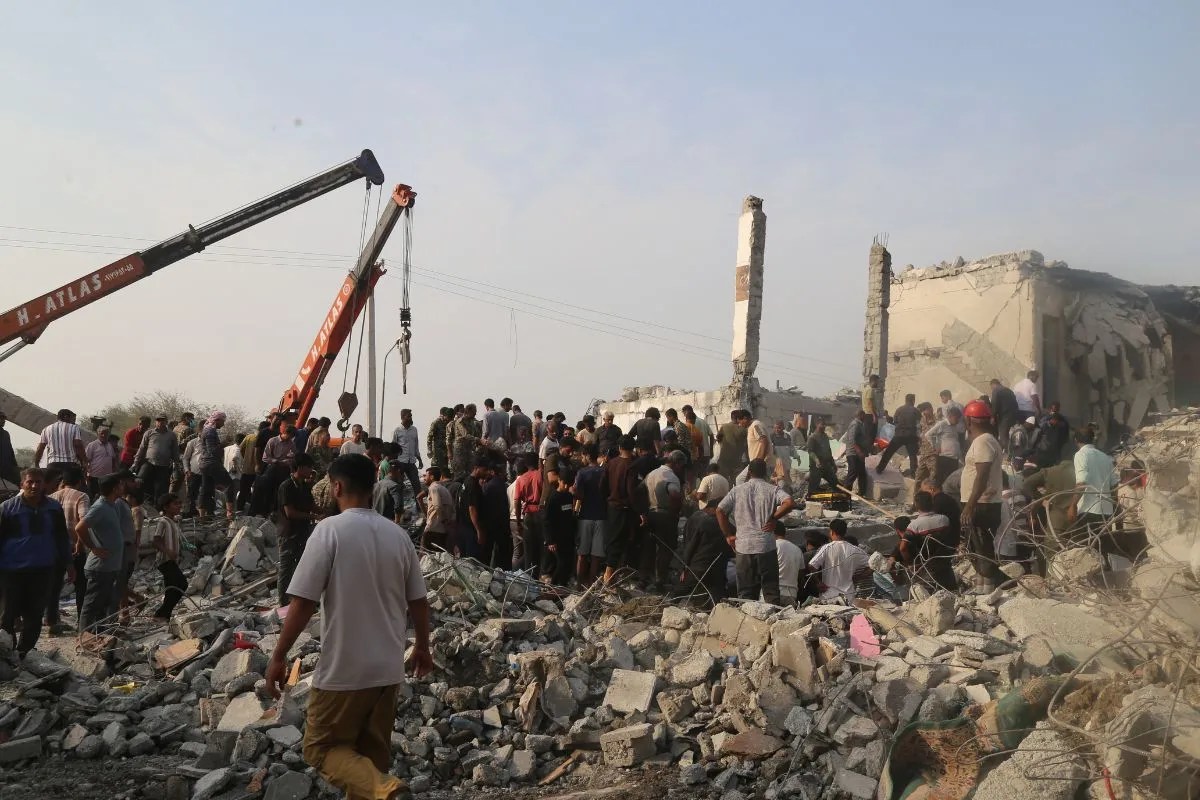
The current friction between Washington and Tehran has shifted from a state of managed proxy friction to a high-probability kinetic collision. This transition is not defined by rhetoric but by the breach of specific operational thresholds. When Iranian leadership issues direct warnings regarding the targeting of non-combatants or "innocent children," they are not merely engaging in moral signaling; they are establishing a legal and domestic justification for a "proportional" retaliatory strike. This tactical posture relies on the principle of Reciprocal Deterrence, where the perceived violation of humanitarian norms by one party is used to authorize the suspension of those same norms by the other.
The Three Pillars of Iranian Retaliatory Logic
To understand the current escalation, one must categorize the Iranian response mechanism into three distinct functional pillars. These pillars dictate how and where Tehran will apply pressure following perceived US transgressions.
- The Information Warfare Axis: This involves the rapid dissemination of casualty imagery to mobilize regional proxies (the "Axis of Resistance"). By framing US actions as targeting the vulnerable, Tehran diminishes the political capital of US-aligned Arab states, making it functionally impossible for those states to offer logistical or intelligence support to American operations.
- The Proxy Distribution Network: Iran rarely engages in direct state-on-state kinetic action when a proxy can achieve the same result with lower sovereign risk. The "price" of an American strike is often extracted through increased frequency of Unmanned Aerial System (UAS) attacks on US assets in Iraq and Syria, or maritime interdictions in the Strait of Hormuz.
- The Symbolic Redline: This is the most volatile pillar. When high-level officials like the IRGC commanders issue specific warnings, they anchor their own credibility to a response. Failing to respond after such a public declaration creates a "deterrence deficit," which the Iranian military doctrine views as an invitation for further US aggression.
The Cost Function of Kinetic Engagement
The calculus of a US strike in the Middle East is governed by a complex cost function. The primary variable is not the immediate success of the mission, but the secondary and tertiary ripple effects.
$Cost = (Target Value) - (Retaliatory Damage + Diplomatic Erosion + Resource Depletion)$
In the context of the recent accusations regarding civilian casualties, the "Diplomatic Erosion" variable increases exponentially. The US military utilizes high-precision munitions—such as the R9X "Flying Ginsu" or small-diameter bombs (SDBs)—specifically to minimize collateral damage. However, in an asymmetric environment, the perception of failure is as strategically significant as the failure itself. If Iran can successfully frame a strike as a violation of the Law of Armed Conflict (LOAC), they effectively "tax" the US's ability to conduct future operations in that theater.
Mechanical Failures in the Deterrence Model
The standard model of deterrence assumes both parties are rational actors with a shared understanding of "red lines." This model is currently breaking down due to three structural bottlenecks:
- Intelligence Asymmetry: The US relies on signal and electronic intelligence (SIGINT/ELINT), while Iran excels in human intelligence (HUMINT) and localized psychological operations. This creates a gap where one side believes they are conducting a clean, surgical strike while the other side is prepared to present a narrative of carnage.
- The Threshold of Pain: Washington views economic sanctions as a primary tool of de-escalation. Tehran, having integrated "Resistance Economics" into its state structure for decades, views these same sanctions as a baseline reality rather than a deterrent. This renders the primary US leverage point ineffective.
- Technological Proliferation: The barrier to entry for high-impact retaliation has collapsed. The use of low-cost, off-the-shelf components in "kamikaze" drones allows Iranian-aligned groups to bypass multi-billion dollar air defense systems like the Patriot or THAAD.
Quantifying the Retaliatory Cycle
The sequence of escalation usually follows a predictable mathematical progression.
- Observation: Identification of a high-value target or perceived violation.
- Vocalization: Public warnings to establish the moral high ground (the current stage).
- Surrogate Strike: A localized attack by a proxy group to test the air defense readiness of the target.
- Assessment: Analyzing the US response to the surrogate strike. If the US response is deemed "weak," a larger, more direct operation is authorized.
This cycle is accelerated by the integration of AI-driven surveillance on both sides. Automated detection of troop movements or carrier strike group positioning reduces the "decision window" for commanders, making accidental escalation more likely than intentional war.
The Maritime Vulnerability Vector
While much of the rhetoric focuses on land-based strikes, the true strategic vulnerability lies in the maritime domain. 15-20% of the world's daily petroleum consumption passes through the Strait of Hormuz. Iran’s naval strategy focuses on "Swarm Tactics," utilizing hundreds of fast-attack craft armed with short-range missiles.
This creates a "Cost Imbalance." A single US destroyer costs approximately 2 billion USD. The swarm of boats required to disable its sensors or overwhelm its CIWS (Close-In Weapon System) costs less than 5 million USD. The physics of the Strait—narrow channels and shallow water—favors the defender's asymmetric assets over the attacker's power projection.
Strategic Realignment Requirements
The current trajectory indicates that traditional "tit-for-tat" kinetic exchanges are no longer yielding stability. To move beyond the current deadlock, the US and its allies must address the "Legitimacy Gap" that Iran exploits following every strike.
The first requirement is the implementation of near-real-time declassification of strike footage. If the US cannot provide immediate, verifiable evidence that counters the "innocent children" narrative, they lose the information war within the first six hours of an operation.
The second requirement is the decoupling of regional security from oil prices. As long as Iranian threats to the Strait of Hormuz can cause global economic shocks, Tehran maintains a "Strategic Ransom" over Western policy.
The final play is a shift toward Integrated Deterrence. This involves syncing economic, cyber, and kinetic tools so that a response to an Iranian warning isn't just a missile launch, but a systematic shutdown of the financial architecture that funds the specific IRGC unit involved. The goal is to make the cost of "taking revenge" higher than the domestic political benefit of the rhetoric.
Direct kinetic confrontation is an outdated metric of success; the true objective is the neutralization of the opponent's ability to command and control their narrative. Any future US operations must be predicated on the fact that the battle for the "story" of the strike is as critical as the physical destruction of the target. Failing to account for this ensures a perpetual cycle of escalation where the "truth" is whatever the most aggressive actor broadcasts first.