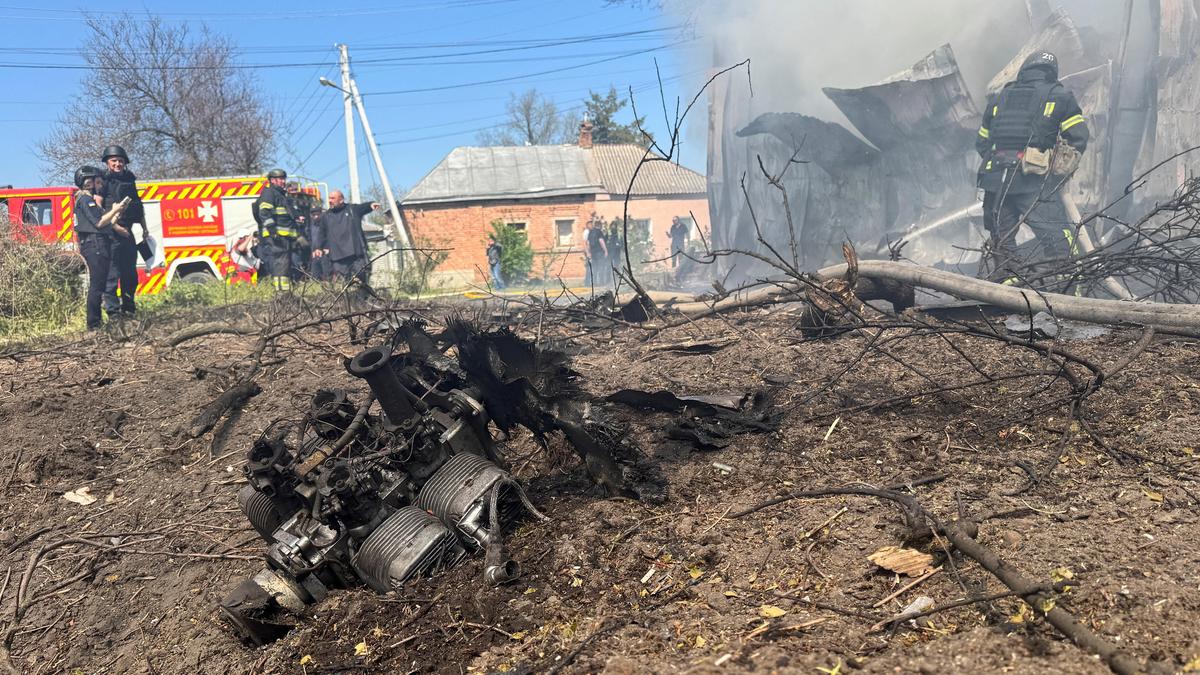
The escalation of long-range strike capabilities in the Russo-Ukrainian conflict represents a shift from tactical battlefield support to a strategic coercion model. When Russia characterizes a "major drone attack" as a response to a rejected ceasefire, it obscures the underlying mechanics of modern attrition. Ceasefire offers in this context are not humanitarian gestures but are deployed as operational pauses intended to reset logistics chains and solidify territorial gains. Ukraine’s refusal to engage in these pauses, followed by intensified drone strikes, indicates a calculated effort to maintain kinetic pressure while Russian offensive momentum fluctuates.
The Logic of the Asymmetric Strike Envelope
The utility of massed drone strikes is defined by the cost-exchange ratio. Unlike traditional ballistic missiles, which require high-capital investment and specialized launch platforms, long-range unmanned aerial vehicles (UAVs) function as "disposable precision." The objective of a 50-plus drone swarm is rarely the total destruction of a single hardened target; rather, it is the saturation of Integrated Air Defense Systems (IADS).
The strategic calculus of these strikes rests on three distinct operational pillars:
- IADS Depletion: Forcing the defender to expend high-cost interceptor missiles—often costing $1 million to $2 million per unit—against low-cost wooden or composite drones priced under $50,000. This creates an economic drain that outpaces the defender’s replenishment rate.
- Logistical Disruption: Targeting fuel depots, electrical substations, and rail nodes far behind the front lines. By increasing the "friction" of moving supplies to the Donbas or Southern fronts, the attacker slows the operational tempo of the opposing army.
- Psychological Parity: Neutralizing the perceived safety of the interior. When Moscow or deep-rear Russian territories are hit, it forces the Russian Ministry of Defense to redeploy air defense assets from the front lines back to urban centers, thinning the protection of active combat units.
The rejection of a ceasefire removes the diplomatic "safety valve," signaling that Ukraine views the current Russian posture not as a stalemate, but as a window of vulnerability.
The False Signal of the Ceasefire Overture
In military theory, a ceasefire proposed by a consolidating power often serves as a "Refit and Re-arm" (R&R) window. If Russia’s military industrial base is struggling with the production of high-end optics or microelectronics due to sanctions, a cessation of hostilities provides the necessary time to source alternative components or stabilize domestic production.
The timing of the Russian ceasefire offer followed by the Ukrainian drone response suggests a fundamental disagreement on the Status Quo Ante. From a structural standpoint, a ceasefire favors the party that currently holds the defensive advantage on the ground. By halting movement, Russia would codify its current defensive lines, making any future Ukrainian counter-offensive significantly more "expensive" in terms of manpower and material. Ukraine’s drone campaign serves as a physical rebuttal, proving that they possess the reach to ignore the front-line stalemate and strike the Russian core.
The Technical Evolution of the Swarm Mechanism
The "major drone attack" cited by Russian officials likely utilized a mix of "loitering munitions" and "decoy drones." To understand the effectiveness of these missions, we must analyze the signal-to-noise ratio of modern radar.
- Decoy Saturation: The first wave of a drone attack often consists of cheap, non-lethal airframes designed to mimic the radar signature of larger missiles. This "lights up" the defender’s radar, revealing the locations of hidden Surface-to-Air Missile (SAM) batteries.
- Kinetic Follow-through: Once the air defense positions are geolocated via electronic intelligence (ELINT), the second wave of armed drones—utilizing GNSS-independent navigation such as terrain contour matching or optical flow—targets the identified batteries or the primary objective.
- Frequency Hopping and Jamming Resistance: Modern Ukrainian UAVs have transitioned from simple remote-controlled links to autonomous flight paths. This renders traditional electronic warfare (EW) "bubbles" less effective, as the drone does not rely on a continuous signal from a ground station to reach its target.
This technical progression means that "major attacks" are no longer just about the number of drones, but about the sophistication of the mission software. Russia's claims of shooting down the majority of incoming craft often ignore the secondary objective: the forced disclosure of Russian defensive positions and the depletion of their missile stocks.
Structural Bottlenecks in Russian Response Patterns
The Russian state's reaction to these strikes follows a predictable cycle of rhetoric and localized escalation. However, the structural limitation of the Russian military remains its centralized command structure. Drone strikes on logistics hubs create a "cascade failure" in this top-down system. When a command post or a regional fuel hub is neutralized, the subordinate units are often unable to pivot without direct orders, leading to localized paralysis.
The drone strikes also expose the geographic vulnerability of Russia’s energy infrastructure. Much of Russia’s refined oil capacity is located within a 1,000-kilometer radius of the Ukrainian border. This puts the primary source of Russian state revenue within the operational range of mass-produced UAVs.
This leads to an inescapable cost function for the Kremlin:
- Scenario A: Deploy heavy IADS to protect oil refineries, leaving the frontline troops vulnerable to Ukrainian air power.
- Scenario B: Prioritize the front lines, leaving the economic engine of the state open to "disposable" drone strikes that cause hundreds of millions of dollars in infrastructure damage.
The Absence of a Diplomatic Off-Ramp
The failure of the ceasefire offer indicates that neither party currently views the cost of continued conflict as higher than the cost of a compromised peace. In game theory terms, this is a "non-cooperative game" where both players believe they have a dominant strategy that leads to a better outcome than negotiation.
For Ukraine, the dominant strategy is the internationalization of the conflict's costs. By striking deep into Russia, they force the Russian civilian population and leadership to experience the material costs of the war, hoping to break the domestic social contract. For Russia, the dominant strategy is "strategic patience," relying on the assumption that Western industrial support for Ukraine will hit a ceiling before the Russian economy collapses.
The drone attacks are the physical manifestation of Ukraine's attempt to lower that Russian ceiling.
Strategic Forecast: The Shift to Autonomous Swarms
The next phase of this kinetic exchange will likely move away from human-piloted drones toward AI-integrated swarms that communicate with one another in flight. This removes the "single point of failure" of a lead drone. If three drones in a ten-unit swarm are intercepted, the remaining seven will autonomously redistribute their target priorities.
Russia will likely respond by attempting to create "hardened" corridors through the mass deployment of short-range point defense systems like the Pantsir-S1. However, the sheer scale of the Russian border makes a total "iron dome" impossible. The border is too porous, and the cost of defending every square kilometer of airspace is mathematically unsustainable.
The conflict has entered a stage where the "front line" is a vestigial concept. The real theater of operations is the 1,500-kilometer depth of the adversary's logistics and economic infrastructure. Ukraine’s refusal to accept a ceasefire is a commitment to this deep-strike strategy.
The strategic priority for any observing power is the recognition that the "ceasefire" was never a viable diplomatic path; it was a contested operational variable. Success in this environment requires the rapid scaling of low-cost autonomous systems and the abandonment of the "expensive interceptor" model of air defense. The party that can produce 10,000 $20,000 drones faster than the opponent can produce 1,000 $2 million interceptors will ultimately dictate the terms of the eventual settlement. Kinetic pressure will continue to escalate until the economic cost of defending the interior exceeds the perceived value of the occupied territories.


