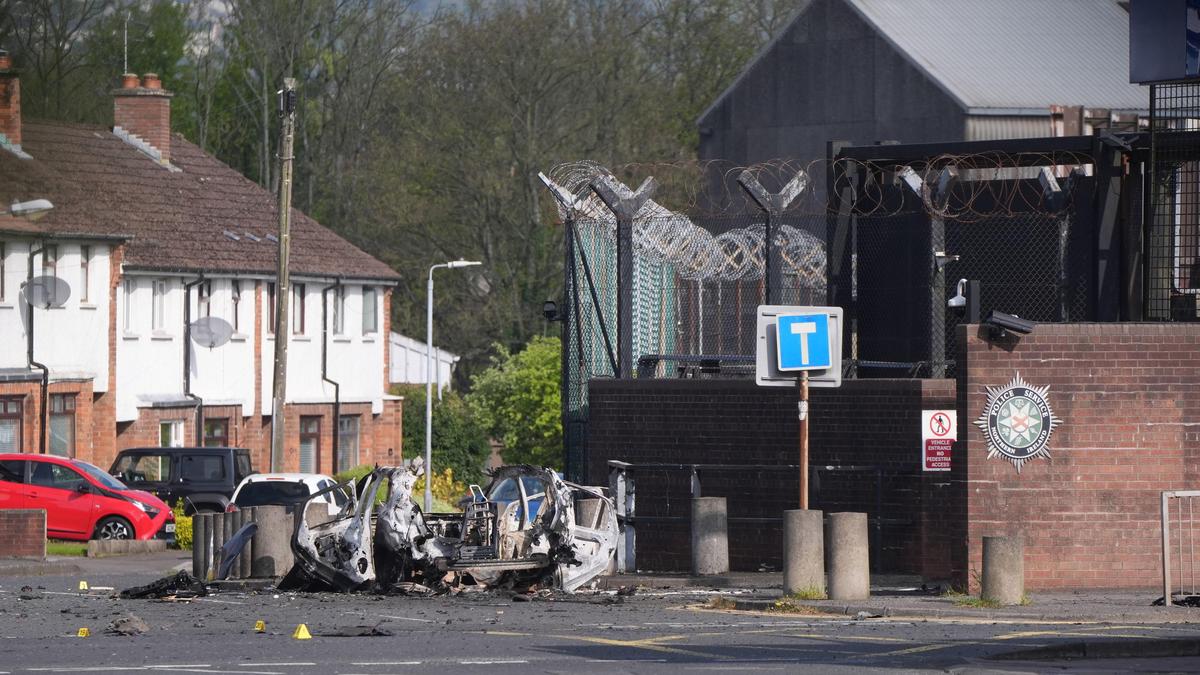
The deployment of improvised explosive devices (IEDs) in Northern Ireland functions not as a bid for conventional military victory, but as a calculated stress test of the post-1998 security architecture. When dissident republican groups utilize car bombings, they are engaging in a strategy of symbolic kineticism designed to provoke a disproportionate state response, thereby delegitimizing current policing models. The effectiveness of these operations is measured by the duration of the subsequent "security freeze" rather than the physical radius of the blast.
The Tripartite Logic of Dissident Operations
Understanding the resurgence of vehicle-borne improvised explosive devices (VBIEDs) requires a move beyond simple labels of "terrorism" toward a functional breakdown of why these specific tactics are selected. Dissident republican strategy relies on three distinct operational pillars.
1. The Disruption of Normalization
The primary objective of a car bomb in a modern urban center like Derry or Belfast is the forced re-militarization of the environment. The Police Service of Northern Ireland (PSNI) operates on a philosophy of community-led policing. A bombing forces a shift back to high-visibility, armored, and exclusionary security cordons. This transition erodes the "normalization" of the state, signaling to the local population that the peace process is a fragile veneer rather than a settled reality.
2. Recruitment through Reaction
The "action-reaction-spiral" remains the foundational recruitment tool for paramilitary remnants. By initiating a kinetic event, these groups anticipate a surge in stop-and-search operations and house raids. The friction generated between the youth population and security forces during these high-tension windows provides the social capital necessary for radicalization. The bomb serves as the catalyst for state-led friction.
3. Proof of Technical Continuity
A functioning VBIED serves as a technical resume. It demonstrates a functioning supply chain for explosives (often commercial grade or "home-made" mixtures like ANFO), a secure workshop environment for vehicle modification, and a cell structure capable of bypass-testing high-density CCTV networks. Each successful detonation signals to both the state and potential recruits that the logistical capability for violence has not been successfully decommissioned.
The Cost Function of Low-Intensity Conflict
Security analysts often fail to quantify the economic asymmetry of these events. The financial burden of a single car bomb is heavily weighted against the state, creating a sustainable model for long-term attrition.
- Manufacturing Costs: A rudimentary VBIED can be assembled for less than £2,000, utilizing stolen vehicles and repurposed agricultural chemicals.
- Response Costs: The deployment of Explosive Ordnance Disposal (EOD) teams, forensic specialists, cordoning personnel, and subsequent intelligence reviews can cost the state upwards of £250,000 per incident.
- Economic Opportunity Cost: The closure of retail hubs and the chilling effect on foreign direct investment (FDI) represent a secondary, much larger financial drain.
This 125:1 cost-to-response ratio ensures that dissident groups do not need a large treasury to exert significant pressure on the regional budget. They are not seeking to bankrupt the United Kingdom, but to make the cost of maintaining "peace" in Northern Ireland a perpetual and painful line item in the national accounts.
Intelligence Bottlenecks and the Signal-to-Noise Problem
The PSNI and MI5 face a structural challenge in identifying these threats due to the shift from hierarchical commands to "flat" organizational structures. Modern dissident activity is characterized by fluid, cell-based networks that lack a central "brain" to decapitate.
The primary bottleneck in preventing these attacks is the signal-to-noise ratio in human intelligence (HUMINT). In small, tightly-knit communities, the introduction of a state informant is increasingly difficult. Intelligence agencies are forced to rely on SIGINT (signals intelligence), which is easily circumvented by "low-tech" communication methods such as face-to-face meetings in public spaces or the use of "burner" hardware.
Furthermore, the "lone actor" or "small cell" phenomenon creates a vacuum of predictable patterns. When a group lacks a formal manifesto or a consistent operational tempo, the state cannot use historical data to predict the next strike. This unpredictability is a deliberate tactical choice designed to keep security forces in a state of perpetual, resource-draining readiness.
The Mechanics of the VBIED as a Political Tool
A car bomb is a specific choice of medium. Unlike a targeted shooting, which is precise and often personal, a VBIED is indiscriminate and theatrical.
The mechanism of the car bomb utilizes the geography of the city against itself. Urban centers in Northern Ireland were redesigned post-Troubles to be open and accessible. This "open city" architecture, while beneficial for commerce, provides an infinite array of soft targets. By placing an explosive in a vehicle, the perpetrator utilizes a ubiquitous object—the car—as a Trojan horse. This creates a psychological "ambient threat" where every parked vehicle becomes a potential weapon in the eyes of the public, effectively undoing decades of psychological demilitarization.
Analyzing the "Dissident" Classification
The term "dissident republican" is often used as a catch-all, but it masks a fragmented landscape of varying capabilities. We must distinguish between three levels of threat:
- The Legacy Operators: Individuals with experience from the 1970s-90s who possess the technical knowledge for bomb-making and counter-surveillance.
- The Political Fronts: Groups that provide the ideological justification for violence, serving as a bridge between legal protest and illegal activity.
- The Ad-hoc Militants: Younger, less experienced individuals who provide the "muscle" for transport and placement.
The current threat level "Substantial" reflects a synergy between these three groups. The legacy operators provide the blueprints, the political fronts provide the motivation, and the ad-hoc militants provide the execution. The failure of the state to offer a viable socio-economic alternative to the third group is the primary driver of persistent instability.
Structural Vulnerabilities in the Current Security Model
The current policing model in Northern Ireland is built on the assumption of a "consensual" society. This model breaks down in areas where the state's monopoly on force is contested.
The reliance on technology—CCTV, facial recognition, and digital tracking—has created a false sense of security. Dissidents have adapted by operating in "dark zones" where technical surveillance is absent or easily sabotaged. This creates a "blind spot" that can only be filled by community policing, which is precisely what the bombings are designed to destroy.
The second vulnerability is the political paralysis at Stormont. A lack of functioning regional government creates a vacuum of authority. In this vacuum, paramilitaries position themselves as the "true" representatives of their communities, offering a perverse form of order and justice that competes with the state. The car bomb is the ultimate assertion of this competing authority.
Strategic Pivot: Moving from Containment to Neutralization
Current policy focuses on containment—reacting to events and managing the aftermath. To neutralize the threat, the focus must shift toward dismantling the logistical and social infrastructure that sustains these groups.
The state must address the "economic oxygen" of dissident groups. Many of these organizations are funded through "gray market" activities: cigarette smuggling, fuel laundering, and extortion. Treating these as simple criminal matters ignores their role in financing political violence. A hard-line disruption of these financial flows is more effective than any counter-terror raid.
Simultaneously, the PSNI must resist the urge to return to "fortress policing." Every armored vehicle on the street is a tactical victory for the dissident. The counter-intuitive but necessary move is to maintain community-level engagement even in the wake of an attack. This denies the dissident their primary goal: the alienation of the public from the police.
The threat posed by car bombings in Northern Ireland is not a relic of the past, but a contemporary tool of asymmetric warfare. It is a sophisticated attempt to exploit the inherent vulnerabilities of a liberal democratic society. Only by understanding the precise logic of these operations—rather than dismissing them as "senseless violence"—can the state begin to construct a resilient defense. The battle is not for territory, but for the psychological and administrative control of the public space.
The strategic play now is to de-couple the act of violence from its intended political result. If a bomb fails to change the policing model, fails to stop the flow of investment, and fails to provoke a heavy-handed state response, it becomes a high-risk, zero-reward activity for the perpetrator. The ultimate defeat of the dissident movement lies not in a final arrest, but in the irrelevance of their primary weapon.