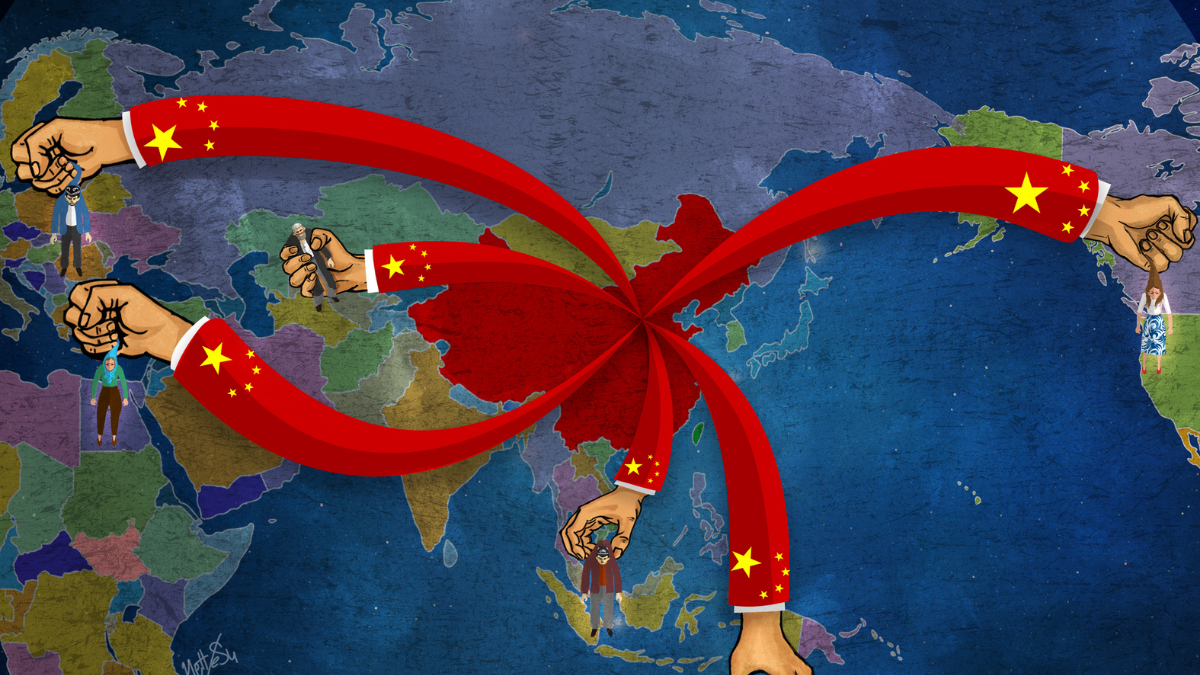
Transnational repression operates as a calculated extension of domestic security frameworks, designed to neutralize perceived threats beyond a state's sovereign borders. When an activist identifies a relative’s detention in Xinjiang as a lever for silence, they are describing a specific operational modality of state power: the weaponization of the family unit as a biological hostage. This mechanism functions through a precise cost-benefit calculus where the state increases the personal "price" of external dissent until it exceeds the individual's capacity to pay, effectively enforcing a borderless censorship regime.
The Tripartite Framework of Extraterritorial Coercion
To understand the detention of Dr. Gulshan Abbas or similar figures, one must categorize the methods of control into three distinct functional pillars. States do not deploy these tactics at random; they are calibrated based on the target’s influence and the accessibility of their social network.
1. Proximal Coercion (The Hostage Variable)
This is the most direct form of leverage. By detaining family members within the mainland, the state creates a "feedback loop" of trauma. The detention is not merely punitive; it is communicative. It signals to the diaspora that their physical distance from the mainland is an illusion. The logic follows a simple equation:
$C = f(A)$
Where the cost to the state ($C$) is a function of the activist’s output ($A$). As the activist increases their global visibility, the state increases the severity of the pressure applied to the domestic "proxy" (the family).
2. Digital Panopticism
Transnational repression relies heavily on the integration of surveillance technology and social engineering. This includes:
- Direct Digital Harassment: Systematic trolling and death threats to induce psychological exhaustion.
- Malware Injection: Sending Pegasus-style or proprietary spyware via familiar communication channels (WeChat, WhatsApp) to map the activist’s network.
- Identity Devaluation: State-sponsored disinformation campaigns designed to ruin the professional reputation of the target, thereby stripping them of their platform.
3. Diplomatic and Institutional Subversion
State actors often exploit the very international systems designed to protect individuals. This includes the abuse of INTERPOL Red Notices to limit an activist’s movement or the use of bilateral extradition treaties. By framing political dissent as "terrorism" or "separatism," the state attempts to outsource its policing to third-party nations, effectively turning the global community into an unwitting enforcement arm.
The Economic Logic of Detainment
State security apparatuses operate under budget constraints and performance metrics. The detention of high-profile individuals—like the sister of an activist—serves a dual-purpose efficiency.
First, it creates a deterrence multiplier. The state does not need to detain every relative of every dissident. It only needs to detain enough recognizable figures to create a climate of "generalized risk." When the risk is perceived as high across the entire diaspora, the community enters a state of self-censorship. This reduces the state’s long-term enforcement costs, as the subjects begin to police themselves.
Second, it facilitates Intelligence Harvesting. Detained relatives are often interrogated specifically about the contacts, funding sources, and upcoming plans of their overseas family members. The information extracted serves as the raw data for the next phase of the crackdown, allowing for targeted rather than scattershot repression.
The Role of Global Supply Chains in Narrative Control
The efficacy of transnational repression is bolstered by economic dependencies. When a state integrates its economy so deeply into global markets—specifically in manufacturing and technology—it gains "reputational insulation."
Corporations and foreign governments often hesitate to challenge specific instances of repression for fear of retaliatory market exclusion. This creates a protectionist shell around the state’s domestic actions. For the activist calling for the release of a family member, they are not just fighting a security bureau; they are fighting an economic behemoth that has made the cost of intervention prohibitively high for Western stakeholders.
Technological Asymmetry and the Modern Dissident
The activist’s struggle is defined by a massive imbalance in resources. A state can mobilize thousands of cyber-operators and billions in AI-driven surveillance capital. In contrast, the dissident relies on decentralized, often volunteer-led advocacy.
The use of Biometric Data Integration is the latest evolution in this repression. When family members in Xinjiang are forced to provide DNA, iris scans, and voiceprints, the state builds a genealogical map that makes it nearly impossible for an individual to truly "disappear" or operate anonymously abroad. Any communication back home immediately flags the overseas participant in a central database, linking their foreign IP address to their domestic family file.
Systematic Limitations of Current Policy Responses
The primary failure of international law in addressing transnational repression is its territorial bias. Legal systems are designed to handle crimes committed within a jurisdiction. When a threat is issued from a server in Beijing to a laptop in Virginia, or when a sister is arrested in Urumqi to silence a speaker in D.C., the legal chain of custody is broken.
- Jurisdictional Blind Spots: Law enforcement in the host country (e.g., the FBI in the US) can investigate the threat, but they have no power to release the hostage being used as leverage.
- Diplomatic Immunity: Cultural centers or "police stations" operating under the guise of administrative offices often provide the physical infrastructure for state agents to conduct these operations with near-total immunity.
The current response framework is reactive rather than structural. It treats each case as an isolated human rights violation rather than a feature of a globalized security strategy.
Structural Requirements for Neutralizing Extraterritorial Influence
To move beyond the cycle of allegation and denial, a strategic shift is required. The focus must move from individual advocacy to systemic hardening.
- Financial De-indexing of Repressive Entities: Moving beyond simple sanctions toward a total exclusion of firms that provide the surveillance backbone for transnational repression. If a company provides the facial recognition used to track a dissident’s family, that company must be treated as a pariah in global capital markets.
- Transnational Legal Standing: Creating a legal mechanism where victims of extraterritorial coercion can sue state-linked entities in the host country's courts for damages, using frozen state assets as the pool for compensation.
- Encrypted Communication Sovereignty: Governments must protect and promote end-to-end encryption as a fundamental security requirement for diaspora communities, specifically legislating against "backdoor" requirements that state actors exploit.
The objective of the state is to make the activist feel isolated, watched, and responsible for the suffering of their loved ones. Countering this requires a collective security model where the cost of the repression is redirected back onto the state's economic and diplomatic interests.
The immediate tactical move for international actors is the formal designation of "Transnational Repression" as a specific criminal category with its own set of mandatory sanctions. This shifts the burden of proof from the victim to the state actor, requiring them to justify the detention of relatives of activists as a condition for continued diplomatic or economic engagement.
Would you like me to analyze the specific legislative frameworks currently being proposed in the G7 to counter these extraterritorial security operations?