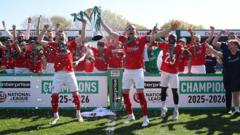
The air in the stadium didn't just carry the scent of mown grass and expensive lager; it carried the weight of thirty years of waiting. You could see it in the knuckles of the man in Row 14, turned white as he gripped a plastic seat that had become his only anchor in a world that was tilting off its axis. He didn’t look like a spectator. He looked like a man standing on the edge of a cliff, waiting for a breeze to decide whether he lived or fell.
This is the reality of a title decider. On paper, it is a mathematical certainty, a collection of points and goal differences that should be clinical. In reality, it is a collective nervous breakdown. The competitor’s reports will tell you the scoreline. They will give you the percentage of possession and the heat maps of the midfielders. But they won’t tell you about the silence. Not the silence of an empty room, but the suffocating, heavy silence that falls over fifty thousand people when the ball hits the back of their net in the eighty-ninth minute. In other updates, take a look at: Strategic Bilateralism in Para Hockey The Canada United States Development Pipeline.
It was their day. Until, quite suddenly, it wasn't.
The Illusion of Control
Success in elite sport is built on the lie that if you work hard enough, the outcome is guaranteed. The players believe it because they have to. The fans believe it because they need to. For eighty minutes, that lie held firm. The home side moved with a predatory grace, the kind of rhythmic efficiency that makes greatness look like an inevitability. Yahoo Sports has also covered this fascinating topic in extensive detail.
They were up by two. The trophy was being polished in a tunnel somewhere, its silver handles catching the artificial light of the stadium corridors. The engraver was likely checking his tools. In the stands, people were already checking flight prices for the victory parade. They were living in a future that hadn't happened yet, spending emotional currency they hadn't actually earned.
Then, a misplaced pass. A slip on a patch of turf that had been watered just a fraction too much.
Chaos doesn't arrive with a fanfare. It creeps in through the smallest cracks. A single goal back for the visitors didn't feel like a threat; it felt like a nuisance. A smudge on a masterpiece. But watch the body language of the captain. See how he looks at the clock, then at his teammates, then back at the clock. The rhythm had broken. The music had stopped, but everyone was still trying to dance, and they were stepping on each other’s toes.
The Physics of the Collapse
Pressure is a physical force. In physics, pressure is defined as $P = \frac{F}{A}$. In a title decider, the force is the expectation of an entire city, and the area is the rectangular patch of grass where eleven tired men are trying to remember how to breathe. When the area remains the same but the force triples, the pressure becomes high enough to crush bone. Or, more accurately, to crush resolve.
The second goal—the equalizer—didn't just level the score. It inverted the gravity of the stadium. Suddenly, the ball felt like it weighed fifty pounds. Professional athletes, men who can hit a moving target from forty yards with their eyes half-closed, began to shank simple clearances into the third tier.
Consider a hypothetical fan named Elias. Elias had saved for six months to be in that seat. He had seen his team lose in the rain in the lower leagues, and he had seen them rise. For him, this wasn't just a game. It was a vindication of every Saturday he’d spent traveling to cold, concrete stadiums in towns the sun forgot. When that second goal went in, Elias didn't scream. He didn't swear. He simply sat down and put his head in his hands.
The human brain isn't wired for the sudden transition from total euphoria to total dread. It’s a chemical whiplash that leaves you numb. The "invisible stakes" aren't about the trophy itself—which is just a hunk of metal—but about the narrative of our lives. If they won, Elias’s years of loyalty meant something. If they lost, he was just a man who had wasted a lot of time and money on a tragedy he couldn't control.
The Sound of the Shift
There is a specific sound a crowd makes when hope dies and is replaced by panic. It’s a low, guttural moan that sits in the back of the throat. It’s the sound of thousands of people realizing they are no longer watching a coronation, but an execution.
The opposition, sensing the shift, became different creatures entirely. Moments before, they were the supporting cast, the "other" team there to fulfill the script. Now, they were the protagonists of someone else's nightmare. They moved faster. They hit harder. They played with the terrifying freedom of men who have nothing to lose, because the world had already written them off.
Every touch from the home side was met with a shrill, desperate whistle from their own supporters. It wasn't malice. It was a plea. Do something. Save us. Fix this. But the players were gone. You could see it in their eyes—the vacant, wide-stare of a deer in the high beams. They weren't playing the team in the red shirts anymore. They were playing against the clock, against the ghosts of past failures, and against the crushing weight of what "should" have been.
The Finality of the Whistle
The third goal, the winner for the visitors, was almost an afterthought. The game had been lost ten minutes earlier in the minds of everyone wearing the home colors. It was a simple tap-in, a clinical finish that felt like a surgical incision.
The stadium didn't erupt in anger. It just... emptied. Not physically—people were still in their seats—but the spirit of the place evaporated. The air went thin.
The competitor’s article will list the final score as a historic upset. They will talk about "tactical shifts" and "substitutions that changed the game." They will use dry, technical language to explain a moment that was purely, brutally human. They will miss the fact that for the players on the pitch, the walk to the dressing room was the longest journey of their lives.
Each step was a confrontation with the reality that they had let a moment slip through their fingers that might never return. Careers in sport are short. Some of those men will never get that close again. They will spend the rest of their lives replaying the eighty-fifth minute in their heads, wondering what would have happened if they’d just kicked the ball out of play, or if they’d tracked that one run into the box.
The trophy was carried away. The engraver packed his tools. The lights dimmed, one bank at a time, casting long, distorted shadows across the pitch.
Outside, in the cold night air, Elias walked toward the train station. He didn't talk to the people around him. There was nothing to say. The sun would come up the next day, and the table would show them in second place, and the world would move on to the next drama, the next "must-see" event.
But for those who were there, the game didn't end with the whistle. It stayed in the lungs like a cold. It lingered in the way they looked at the green grass of the pitch one last time before turning their backs. They arrived expecting a wedding and left attending a funeral, reminded once again that in the theater of the elite, the script is never written in ink, but in the volatile, unpredictable hearts of men who are, despite their god-like status, entirely fragile.
The man in Row 14 finally let go of the seat. His hands were shaking. He didn't look at the scoreboard. He just stared at the empty spot on the podium where the silver should have been, a ghost of a dream that had been theirs, right up until the moment it wasn't.
-1920w.jpg)