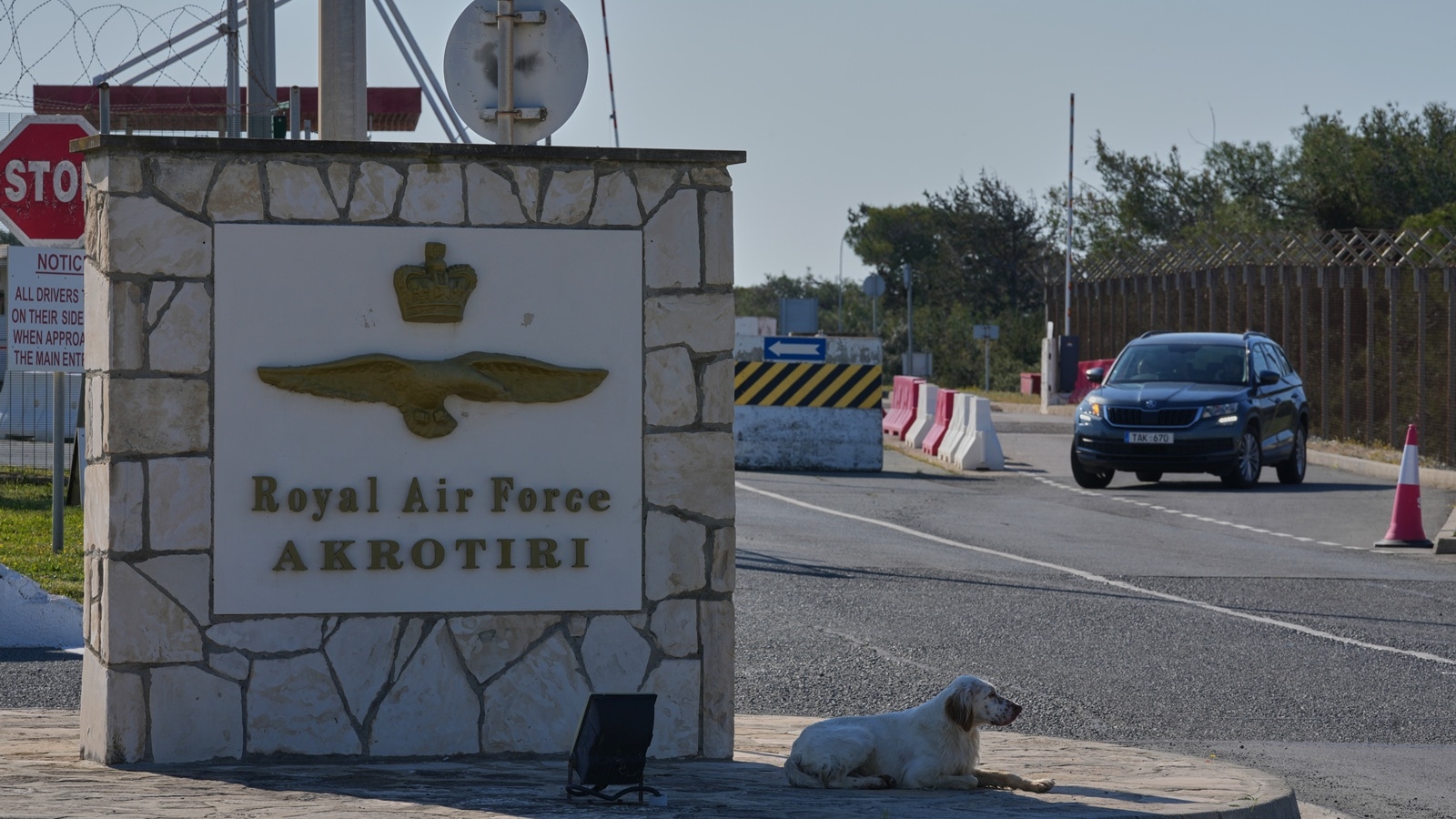
The myth of British non-belligerence in the burgeoning Middle East conflict died at 12:03 a.m. on Monday. When an Iranian-made Shahed drone punched a hole into the runway at RAF Akrotiri in Cyprus, it did more than just scorch asphalt and rattle the windows of nearby Limassol. It effectively ended the fiction that the United Kingdom can act as a silent partner to American military objectives without absorbing the consequences of total war.
The British government spent the morning insisting that the nation is not at war. Foreign Secretary Yvette Cooper and Prime Minister Keir Starmer have maintained a carefully calibrated rhetorical line, describing the UK’s role as "defensive" and "limited." However, the reality on the ground in Cyprus—a sovereign British base area that serves as the crown jewel of RAF operations in the Levant—tells a different story. The strike, followed by the interception of two additional drones hours later, marks the first time since the 1986 Libyan crisis that this strategic outpost has been directly hit. For a different view, read: this related article.
The Geography of Escalation
RAF Akrotiri is not a mere landing strip. It is a massive intelligence and strike hub that covers nearly 3% of the island’s landmass. For decades, it has served as the unsinkable aircraft carrier for Western operations in Iraq, Syria, and Yemen. By striking here, Tehran or its proxies—widely believed to be Lebanese Hezbollah—have sent a message that the Mediterranean is no longer a safe haven for British "defensive support."
The timing of the strike suggests a sophisticated intelligence operation rather than a random act of retaliation. While Starmer claims the drone was launched before he officially authorized the U.S. to use British bases for strikes on Iranian missile sites, the intent was clear. Iran is no longer distinguishing between the hand that pulls the trigger and the hand that holds the ammunition. Related reporting regarding this has been shared by NBC News.
A Failure of Deterrence
Last month, the Ministry of Defence moved extra F-35 fighter jets, advanced radar systems, and counter-drone batteries to Akrotiri. They were supposed to act as a shield. Yet, a relatively low-cost, slow-moving Shahed drone managed to penetrate this high-tech bubble.
This is the central paradox of modern aerial warfare. You can have a billion-pound defense network, but the "asymmetric math" favors the attacker. A drone costing less than a mid-range family car can force a multi-million-pound interceptor into the sky or, as seen on Monday, successfully impact a strategic runway. The "force protection" mentioned by the MoD was at its highest level, yet the perimeter was breached.
The Cypriot Dilemma
The Republic of Cyprus finds itself in an impossible position. President Nikos Christodoulides has been frantic in his attempts to distance his country from the violence, stating flatly that Cyprus is not involved. But the island is a patchwork of jurisdictions. When sirens wail at Akrotiri, they are heard in the civilian streets of Akrotiri village. When Paphos International Airport is evacuated due to a "suspect object" on radar, it is the Cypriot economy and its vital tourism sector that take the hit.
Nicosia’s frustration with London is reaching a breaking point. The Cypriot government has long demanded that British bases be used only for humanitarian purposes. London, citing sovereign rights granted in 1960, effectively ignores these pleas. This creates a dangerous gray zone where an EU member state is being dragged into a regional war against its will because of colonial-era land agreements.
The Myth of Defensive Only
The British government's insistence that it is providing "defensive" support is a distinction that exists only in the halls of Westminster. To an adversary in Tehran, there is no difference between a jet that drops a bomb and a base that provides the fuel, intelligence, and runway for that jet to take off.
By allowing the U.S. to use Diego Garcia and RAF Fairford—and now potentially opening the door for Akrotiri's logistical support—the UK has integrated itself into the American kill chain. The legal summaries published by the government to justify these actions as "collective self-defense" are designed to satisfy domestic critics, but they carry no weight in a theater of war where the enemy uses scorched-earth tactics.
The Long Shadow of Iraq
The ghost of the 2003 Iraq invasion hangs over every statement made by the current cabinet. There is a palpable fear of being seen as the "junior partner" in another open-ended Middle Eastern entanglement. This explains the hesitant, piece-meal announcements regarding military cooperation.
But war has a way of ignoring political nuance.
The evacuation of British families from the base to "alternative accommodation" on the island is a clear admission that the MoD expects more arrivals. You do not move the families of servicemen because of a single, "minimal" strike on a runway. You move them because the intelligence suggests that the opening salvo has only just begun.
Moving Beyond the Rhetoric
Britain cannot continue to claim neutrality while its sovereign territory is being used as a launchpad for the most significant aerial campaign in the region this century. The strike on Akrotiri was a proof of concept for Iran. It demonstrated that they can reach across the sea and touch British soil.
If the UK continues to offer its bases to U.S. forces, it must prepare the British public for the reality that the war will not stay in the Persian Gulf. It will follow the logistics. It will follow the flight paths. It will come to the Mediterranean.
The government needs to stop hiding behind the word "defensive" and start explaining the true cost of the alliances it is choosing to uphold. The runway at Akrotiri can be patched in a few hours. The damage to the illusion of British safety will take much longer to repair.
You should now monitor the movement of Royal Navy frigates toward the Eastern Mediterranean as the next clear indicator of how far this "defensive" posture will actually go.


