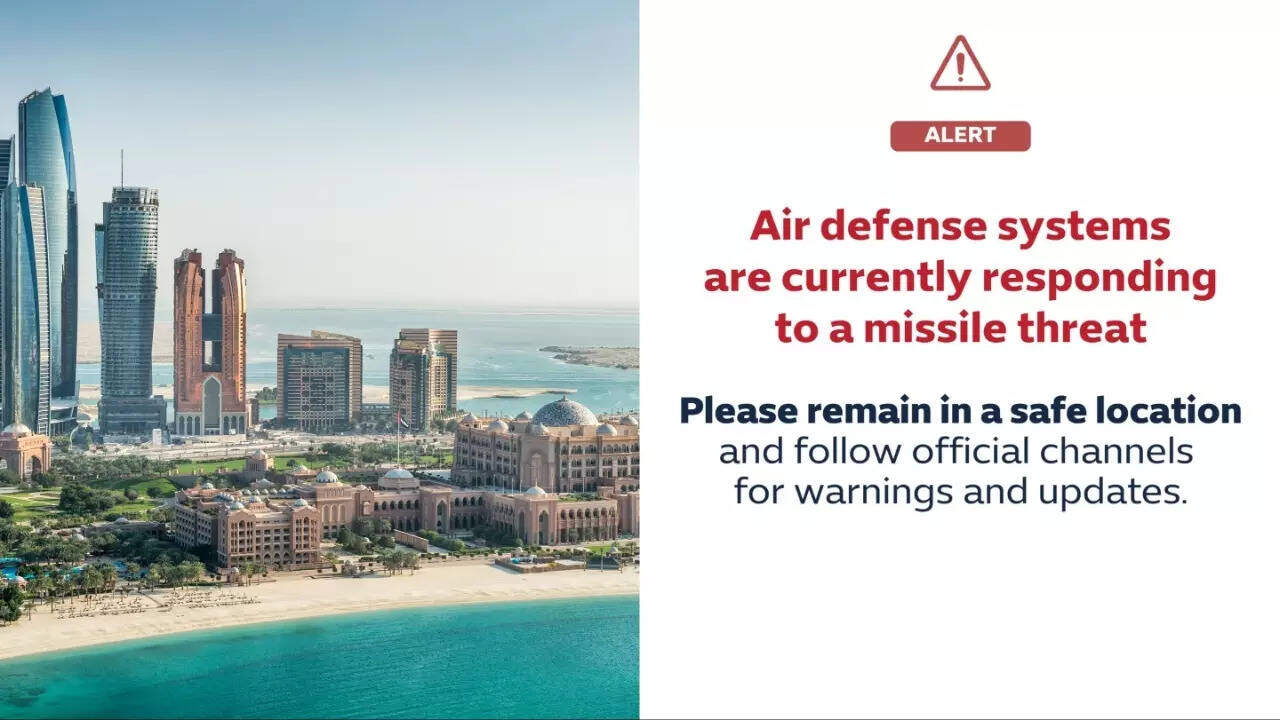
The sky over Abu Dhabi no longer belongs to the civil aviation giants. Since the pre-dawn hours of February 28, 2026, the roar of GE90 engines has been replaced by the rhythmic thud of Patriot Advanced Capability-3 (PAC-3) interceptors and the high-altitude streaks of Terminal High Altitude Area Defense (THAAD) batteries. While the world watches the direct exchange between the United States, Israel, and Iran, the United Arab Emirates is fighting a quiet, desperate war of attrition that threatens to dismantle its decades-long reputation as a safe harbor for global capital.
Abu Dhabi is currently on a footing that hasn't been seen since the formation of the federation. The Ministry of Defence recently confirmed a massive engagement involving seven ballistic missiles and 131 drones in a single wave. Of those, six missiles and 125 drones were neutralized. These are not just numbers on a SITREP; they represent a fundamental failure of the "friends to all" diplomatic strategy that the UAE has meticulously cultivated. Despite official assurances that the nation remains a neutral bystander, the sheer volume of Iranian ordinance—over 238 ballistic missiles and 1,400 drones since the assassination of Ayatollah Ali Khamenei—proves that Tehran no longer makes a distinction between U.S. launchpads and the sovereign territory that hosts them.
The Mathematics of Interception
The UAE’s air defense umbrella is arguably the most sophisticated in the world, yet it is being pushed to its breaking point. To understand the "how" behind the defense, one must look at the layering. At the outer edge, THAAD systems are designed to hit ballistic threats in the exo-atmosphere. Closer in, the PAC-3 MSE (Missile Segment Enhancement) handles the leakers. For the swarms of "suicide drones" or loitering munitions, the UAE relies on a mix of Pantsir-S1 units and increasingly, directed energy prototypes that are being battle-tested in real-time.
The problem is the cost-to-kill ratio. An Iranian-made Shahed-style drone costs roughly $20,000 to $50,000 to produce. A single PAC-3 interceptor carries a price tag of approximately $4 million. Iran is not trying to win a traditional military victory; it is trying to bankrupt the defensive capacity of the Gulf states. By forcing the UAE to expend its high-end interceptors on low-cost drones, Tehran is thinning the shield for the day when a much larger, more sophisticated saturation attack occurs.
Why the "Gentleman's Agreement" Failed
For years, Abu Dhabi operated under a tacit understanding with Tehran. The UAE would limit its involvement in regional escalations, and in return, its glass towers and oil terminals would remain untouched. This "de-escalation first" policy was a response to the 2019 tanker attacks and the 2022 Houthi strikes. But the 2026 conflict has changed the geometry of Middle Eastern warfare.
When the joint U.S.-Israeli operation decapitated the Iranian leadership on February 28, the "gentleman’s agreement" died with the Supreme Leader. Iran’s military command has been devolved, according to intelligence reports, allowing regional commanders to strike "targets of opportunity." This means the UAE is being targeted not because it joined the war, but because its existence as a stable, Western-aligned financial hub is an affront to a regime fighting for its survival.
The humanitarian cost is mounting, though it is often buried in the back of technical military reports. Three expatriate workers from Pakistan, Nepal, and Bangladesh were killed in the initial March waves. Over 100 people have been treated for injuries, many caused not by direct hits, but by the falling debris of "successful" interceptions. When a missile is blown apart at 30,000 feet, the supersonic shrapnel has to go somewhere. In a densely populated city like Abu Dhabi, that "somewhere" is often a residential neighborhood or a commercial district.
The Economic Aftershock
The physical damage is secondary to the economic paralysis. Emirates and Etihad have suspended the bulk of their operations, with only a handful of emergency and repatriation flights operating out of DXB and Zayed International. This is a dagger to the heart of a country that functions as the world's transit lounge.
Furthermore, the "tax residency" crisis is an overlooked byproduct of this kinetic war. Thousands of high-net-worth individuals and corporate executives are currently "stranded" in the UAE due to airspace closures. Under international tax laws, staying in a jurisdiction for more than 182 days can trigger residency and massive tax liabilities. For a country that sells itself on being a tax-efficient, frictionless gateway, the prospect of its residents being trapped in a combat zone while their global tax status shifts is a nightmare scenario for the Ministry of Economy.
The Reliability of the American Shield
There is a growing, bitter resentment within the halls of power in Abu Dhabi and Riyadh regarding the U.S. response. While the Pentagon claims to have "growing control" over Iranian airspace, Gulf officials have observed that U.S. air defense assets have been prioritized to protect Israel and American carrier groups, often leaving the GCC states to fend for themselves with their own stockpiles.
A senior Saudi official recently voiced what many in Abu Dhabi are thinking: "The United States abandoned the Gulf states and redirected its air defense to protect Israel." This perception of betrayal is likely to outlast the current war. Even if the missiles stop flying tomorrow, the UAE’s trust in the U.S. security guarantee has been fundamentally shaken.
We are seeing the birth of a new, more muscular Emirati foreign policy. The UAE has already withdrawn its ambassador from Tehran and is openly discussing the "option to respond" with military force. This is a massive departure from the "diplomacy-first" mantra of the last five years. If the UAE decides to move from a defensive posture to an offensive one, the war will no longer be a contained conflict between the U.S. and Iran—it will become a total regional conflagration.
The air sirens in Abu Dhabi are a wake-up call for the entire global economy. The era of the "safe neutral zone" in the Middle East is over. As long as the missiles continue to rain down, the UAE is no longer just a business hub; it is the front line.
Would you like me to analyze the specific technical capabilities of the THAAD and PAC-3 systems currently deployed in the UAE?